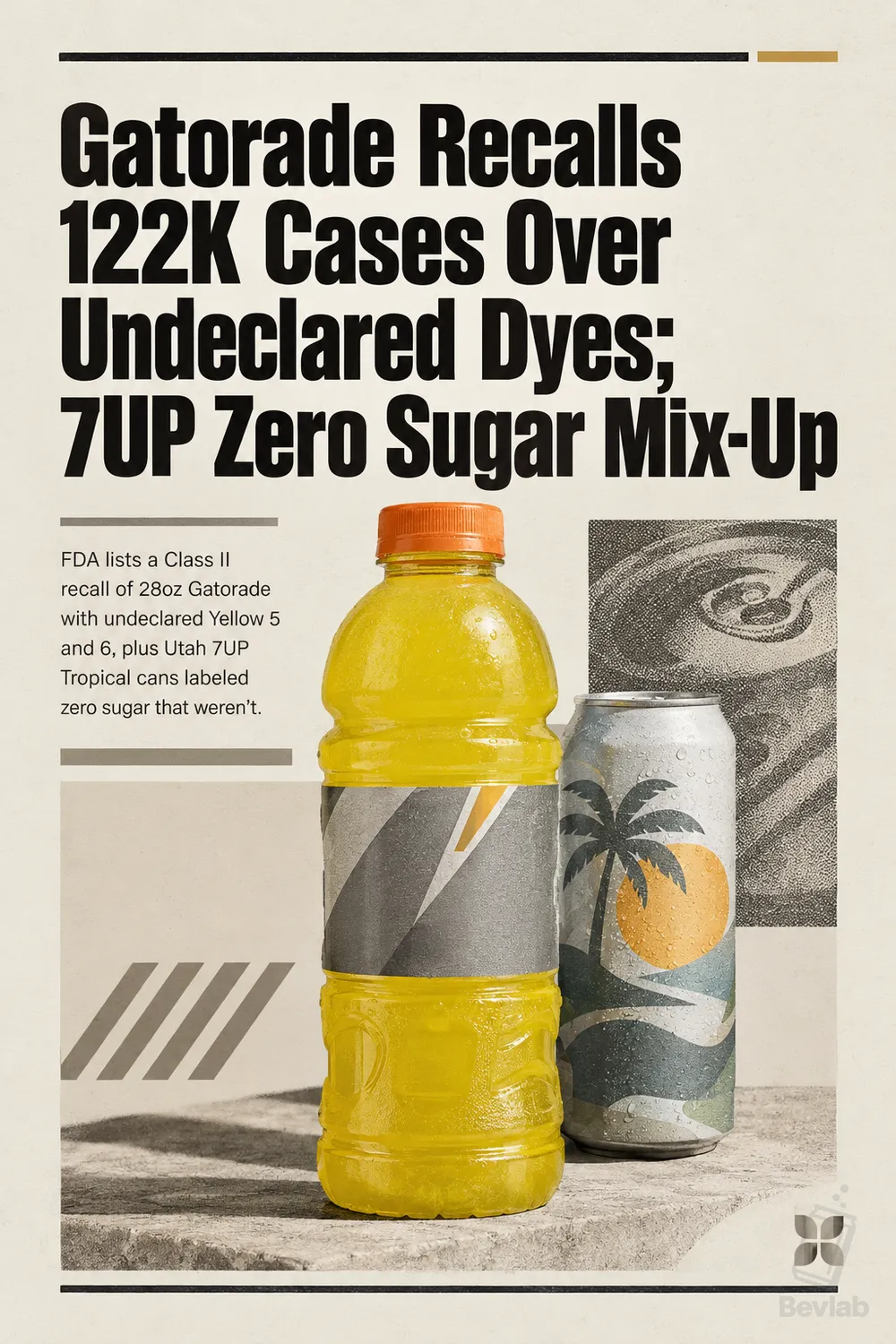
Gatorade Recalls 122K Cases Over Undeclared Dyes; 7UP Zero Sugar Mix-Up
FDA lists a Class II recall of 28oz Gatorade with undeclared Yellow 5 and 6, plus Utah 7UP Tropical cans labeled zero sugar that weren't.
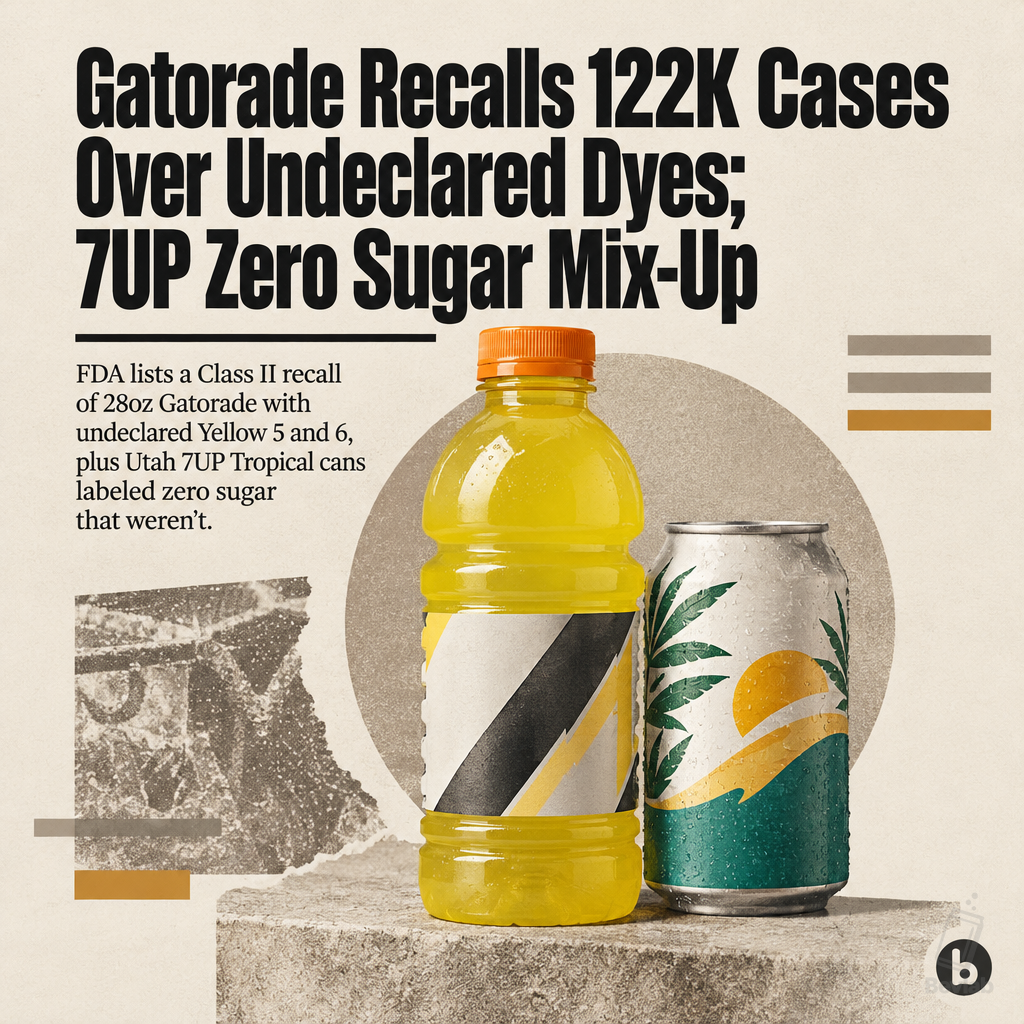
PepsiCo is recalling 122,021 cases of 28oz Gatorade because the drinks may contain Yellow No. 5 and/or Yellow No. 6 that the label doesn't declare. The recall covers four flavors: Gatorade Lemon Lime, Lemon Lime Zero, Orange, and Orange Zero.[1]
PepsiCo started the voluntary recall on September 25, 2026. FDA classified it as Class II on October 2, 2026, and its enforcement report (recall H-0009-2027) still lists it as ongoing.[1] The product went to 37 states: Alabama, Alaska, Arizona, Arkansas, California, Colorado, Florida, Georgia, Hawaii, Idaho, Illinois, Indiana, Iowa, Kansas, Kentucky, Louisiana, Michigan, Minnesota, Mississippi, Missouri, Nebraska, Nevada, New Jersey, New Mexico, New York, North Carolina, North Dakota, Ohio, Oklahoma, Pennsylvania, South Carolina, South Dakota, Tennessee, Texas, Utah, Washington, and Wisconsin.[1]
Class II is FDA's middle tier. It covers cases where drinking the product may cause temporary or medically reversible health effects, or where the chance of serious harm is remote.
Check Your Gatorade Codes
If you have a 28oz Gatorade in one of the four recalled flavors, compare the codes on it to this list:[1]
| Lot Code | Date Code |
|---|---|
| 091026 DL | JUN 07 27 |
| 091126 DL | JUN 08 27 |
| 072226 DT | APR 18 27 |
| 072426 TL | APR 20 27 |
| 073126 TL | APR 27 27 |
| 072926 TL | APR 25 27 |
| 073026 TL | APR 25 27 |
| 081026 TL | MAY 07 27 |
| 082126 OA | APR 18 27 |
| 080126 DL | APR 28 27 |
| 082026 DL | MAY 17 27 |
| 083126 DT | JUN 07 27 |
| 082526 KM | MAY 22 27 |
| 090426 KM | JUN 01 27 |
| 072726 TL | APR 23 27 |
Why Undeclared Yellow 5 Matters
Yellow No. 5, also called tartrazine, is the one with a known sensitivity issue. In its 2009 safety review, the European Food Safety Authority concluded that tartrazine may cause intolerance reactions in a small fraction of people, and that sensitive people can react even at intakes within the acceptable daily limit.[2] That's why FDA requires any food containing it to list "FD&C Yellow No. 5" by name in the ingredients.[3] A lot of parents also skip synthetic dyes for their kids and rely on the ingredient list to do it. When the dye is in the bottle but missing from the label, that list stops being useful.
The timing is awkward. In April 2025, HHS and FDA announced they would work with the food industry to remove six petroleum-based synthetic dyes, including Yellow No. 5 and Yellow No. 6, from the food supply by the end of 2026.[4] This recall arrives with only a few months left before that target.
Utah 7UP Tropical Recall
The second recall is smaller and limited to Utah. Admiral Beverage Corporation recalled 3,240 cases (77,760 cans) of 7UP Tropical 12oz cans sold in 12-pack wraps. The wrap says 7UP Tropical, but some cans inside are labeled 7UP Tropical Zero Sugar and actually contain full-sugar soda.[5]
- Recall number: H-1397-2026
- Lot code: UT06176
- Best By: March 17, 2027
- UPC: 0 78000 03798 2
Admiral started the recall on August 20, 2026. FDA classified it Class II on September 29, 2026, and now lists it as completed.[5] The risk falls mostly on people with diabetes or anyone tracking sugar closely. They'd pick a Zero Sugar can expecting no sugar and get a regular soda. Buffalo Rock's earlier 7UP Zero Sugar Tropical recall in Alabama and Northwest Florida was a separate recall.
What to Do
- Check any 28oz Gatorade Lemon Lime, Lemon Lime Zero, Orange, or Orange Zero against the codes above.
- In Utah, check 7UP Tropical cans for lot UT06176 and a March 17, 2027 Best By date.
- If you're sensitive to Yellow 5 or need to limit sugar, don't drink a matching product. Contact the company that made it for next steps.
If your codes don't match, you don't need to do anything.
References
- U.S. Food and Drug Administration. "Food Enforcement Report: Recall H-0009-2027." openFDA, 2026. https://api.fda.gov/food/enforcement.json?search=recall_number:"H-0009-2027"
- EFSA Panel on Food Additives and Nutrient Sources Added to Food. "Scientific Opinion on the re-evaluation of Tartrazine (E 102)." EFSA Journal, 2009. https://doi.org/10.2903/j.efsa.2009.1331
- U.S. Code of Federal Regulations. "21 CFR 74.705: FD&C Yellow No. 5." Legal Information Institute. https://www.law.cornell.edu/cfr/text/21/74.705
- U.S. Food and Drug Administration. "HHS, FDA to Phase Out Petroleum-Based Synthetic Dyes in Nation's Food Supply." FDA, 2025. https://www.fda.gov/news-events/press-announcements/hhs-fda-phase-out-petroleum-based-synthetic-dyes-nations-food-supply
- U.S. Food and Drug Administration. "Food Enforcement Report: Recall H-1397-2026." openFDA, 2026. https://api.fda.gov/food/enforcement.json?search=recall_number:"H-1397-2026"
Tagged