Slate Ultra Protein 30g: A Milk Shake That Went to the Gym
The middle rung of Slate's protein ladder
No protein powder here: Slate builds this 30g shake on ultrafiltered skim milk and holds sugar to 1g with sucralose and Reb M stevia.
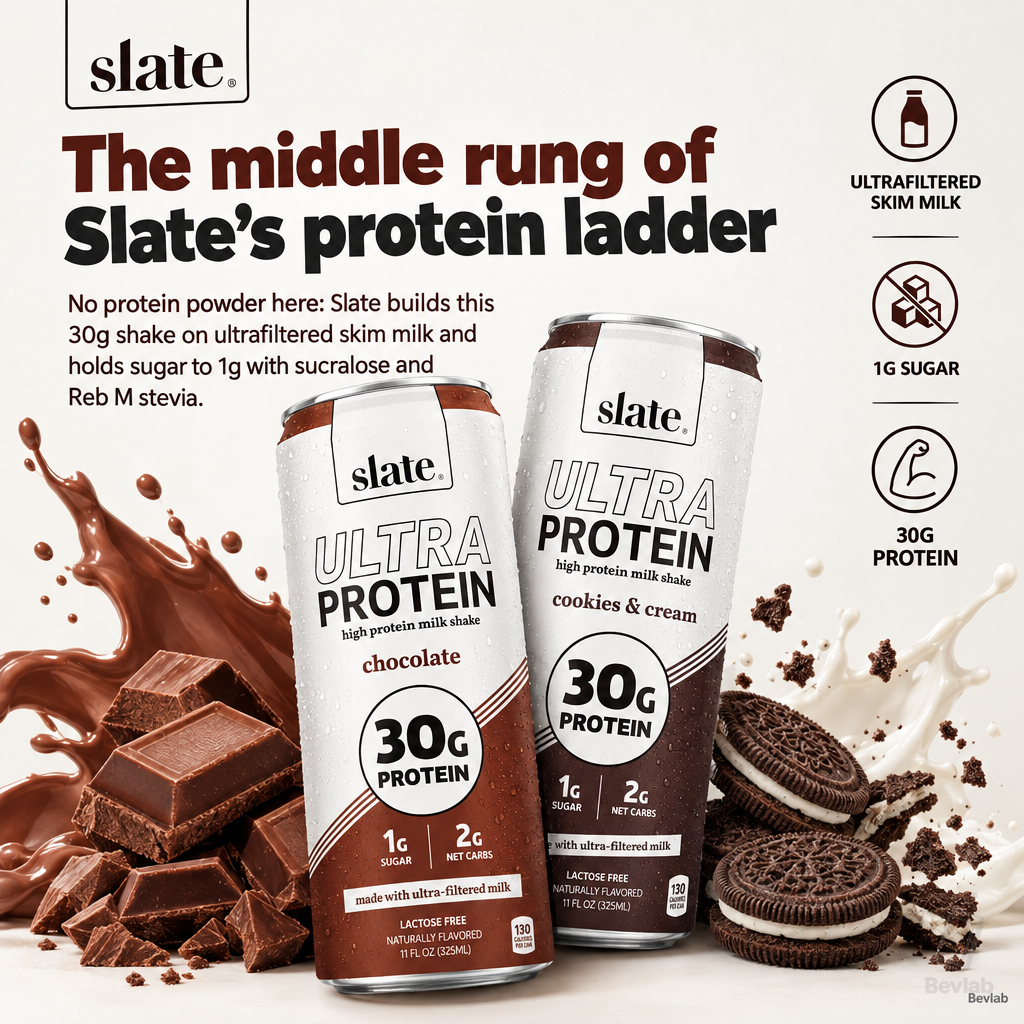
Slate started with a very specific goal. Co-founders Manny Lubin and Josh Belinsky wanted a healthy chocolate milk they could drink every day. After a Kickstarter campaign, a Shark Tank appearance, and hundreds of test batches, the brand launched in late 2019 with three chocolate milk flavors. Slate Ultra Protein 30g takes that idea and turns the protein way up. It comes in an 11 fl oz can that doesn't need refrigeration, and it sits between Slate's 20g milk shakes and the bigger 15 fl oz Slate Ultra Protein 42g.
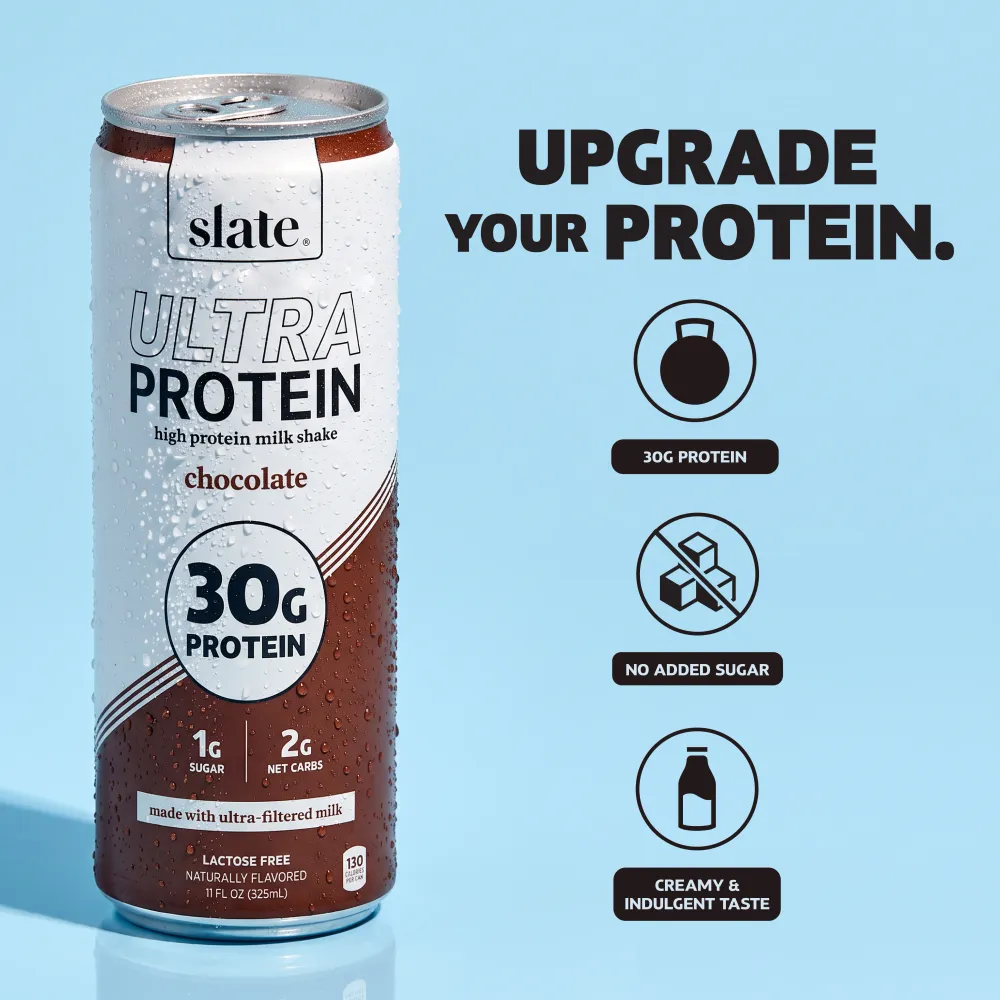
The protein source is the interesting part. You won't find whey isolate or milk protein powder on this label. Slate ultra-filters skim milk to remove lactose and some water, which concentrates the protein the milk already had, and the brand says that's how it gets high protein numbers without adding protein powder. The Chocolate can comes in at 30g protein, 130 calories, 1g sugar, and 0g added sugar. Lactase enzyme is on the label, and sucralose plus Reb M stevia handle the sweetening.
Slate Ultra Protein 30g Nutrition Facts
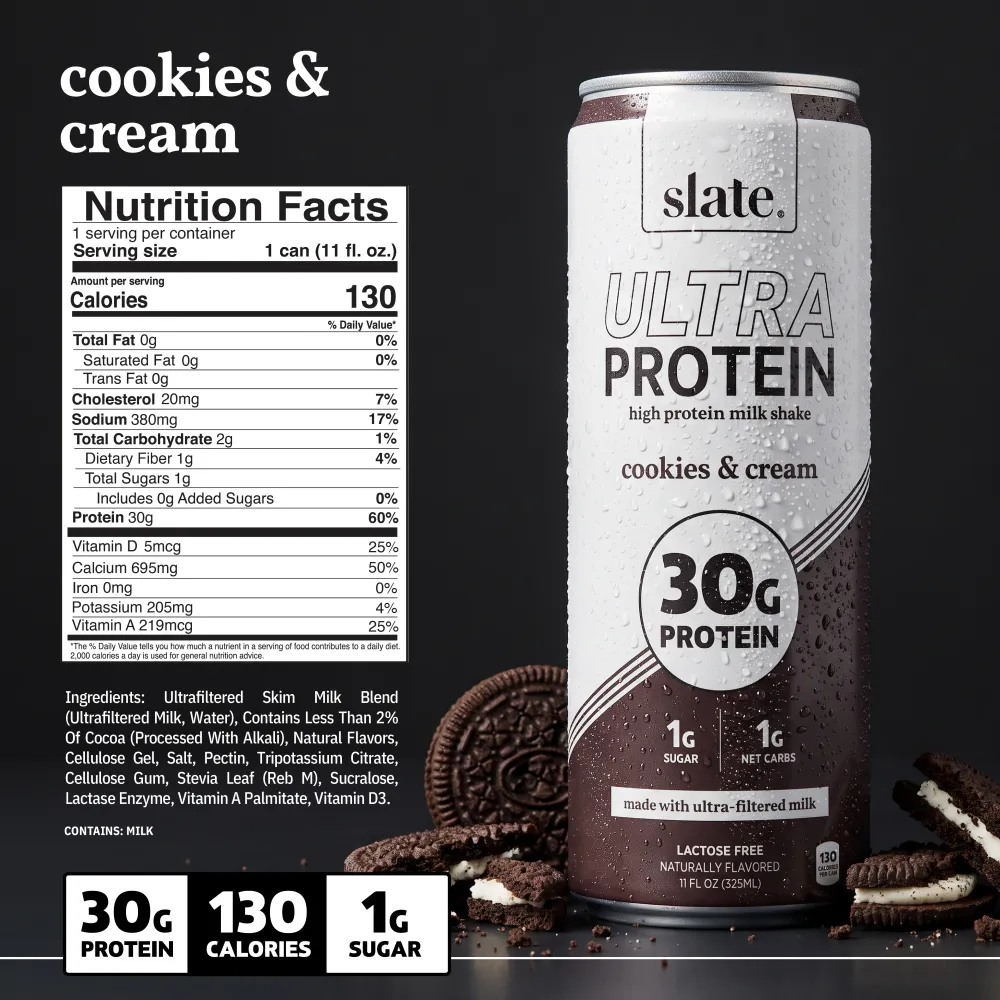
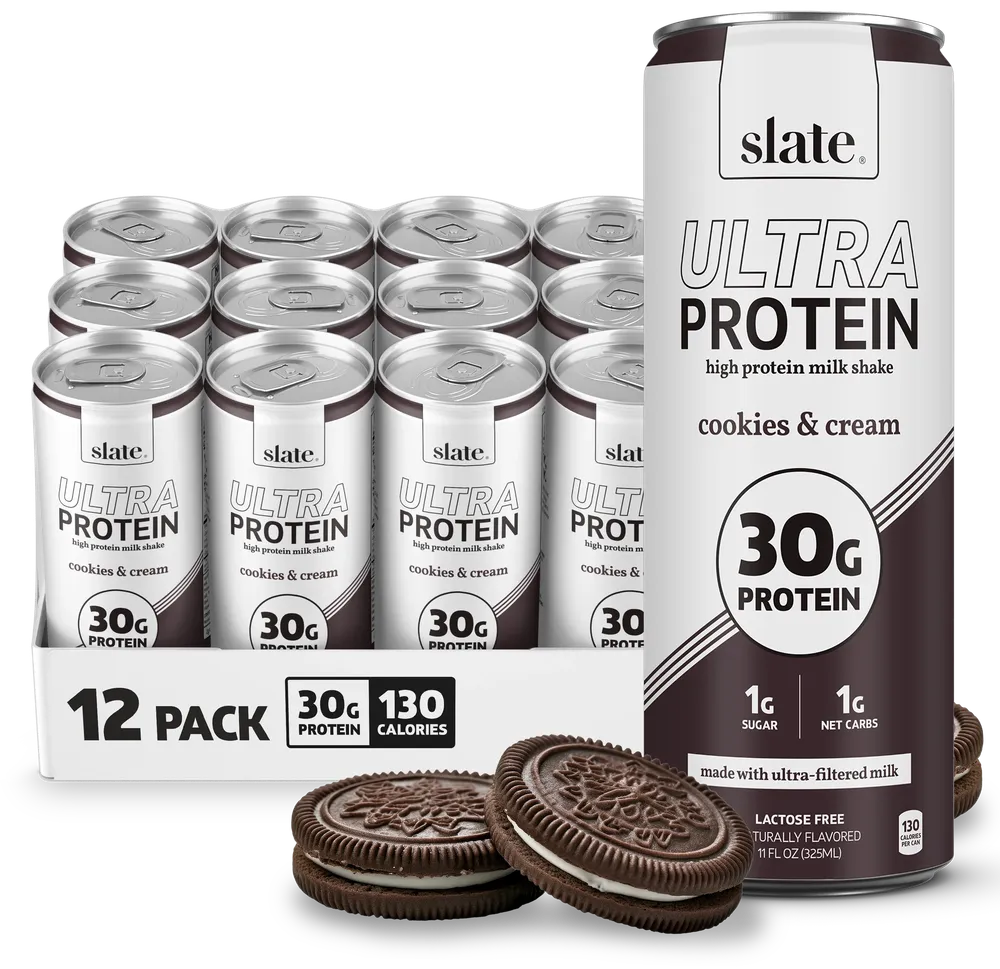
These numbers come from the Chocolate can, which is one 11 fl oz serving. Cookies & Cream has the same 30g protein and 1g sugar, but a few of its panel values are a little different.
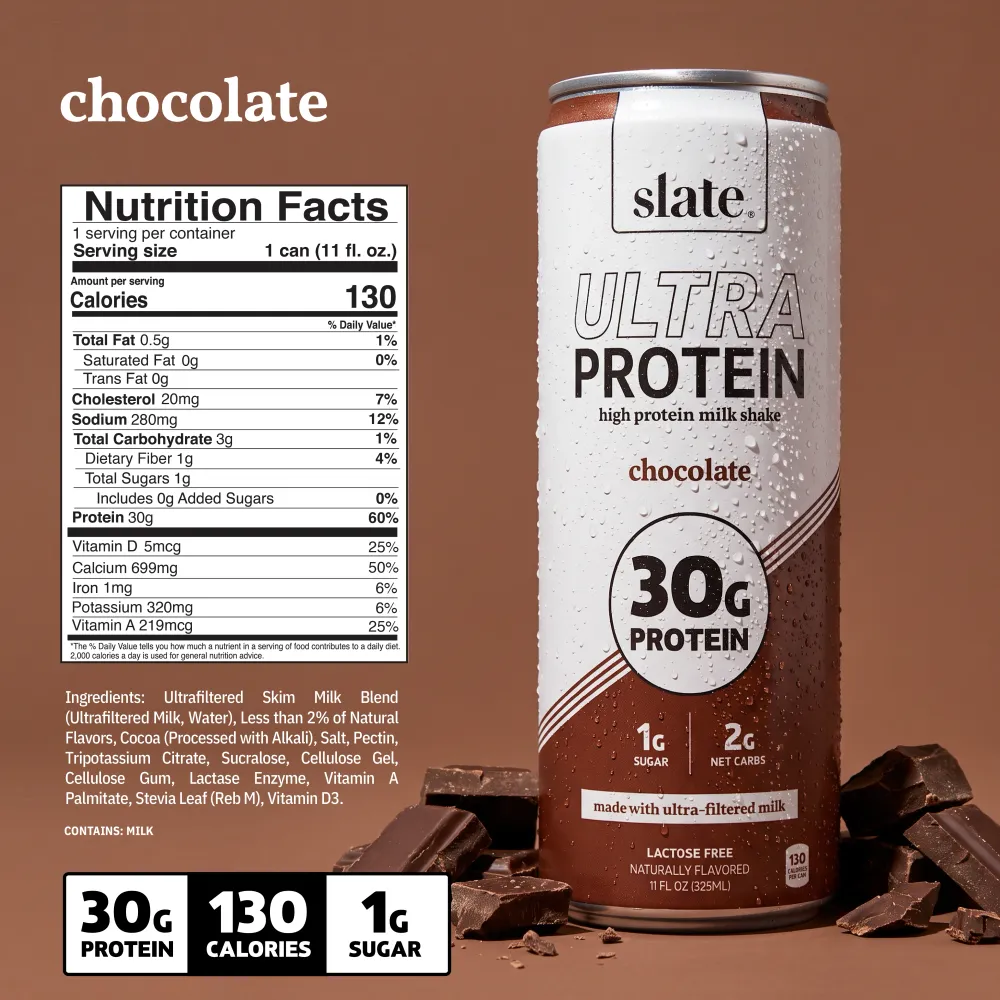
- Calories: 130
- Total Fat: 0.5g (1% DV)
- Saturated Fat: 0g (0% DV)
- Trans Fat: 0g
- Cholesterol: 20mg (7% DV)
- Total Carbohydrate: 3g (1% DV)
- Dietary Fiber: 1g (4% DV)
- Total Sugars: 1g
- Added Sugars: 0g (0% DV)
- Protein: 30g (60% DV)
- Vitamins and Minerals
- Sodium: 280mg (12% DV)
- Potassium: 320mg (6% DV)
- Calcium: 699mg (50% DV)
- Iron: 1mg (6% DV)
- Vitamin A: 219mcg (25% DV)
- Vitamin D: 5mcg (200 IU, 25% DV)
The macro split is what matters here. Protein supplies most of the 130 calories. Carbs stay at 3g, 1g of that is fiber, and the panel lists 0g added sugar. Calcium is the other big number. One can covers half the Daily Value, and that calcium comes from the dairy, not from an added calcium salt.
Slate Ultra Protein 30g Ingredients
Each 11 fl oz can is built around these key actives:
-
Ultrafiltered Skim Milk
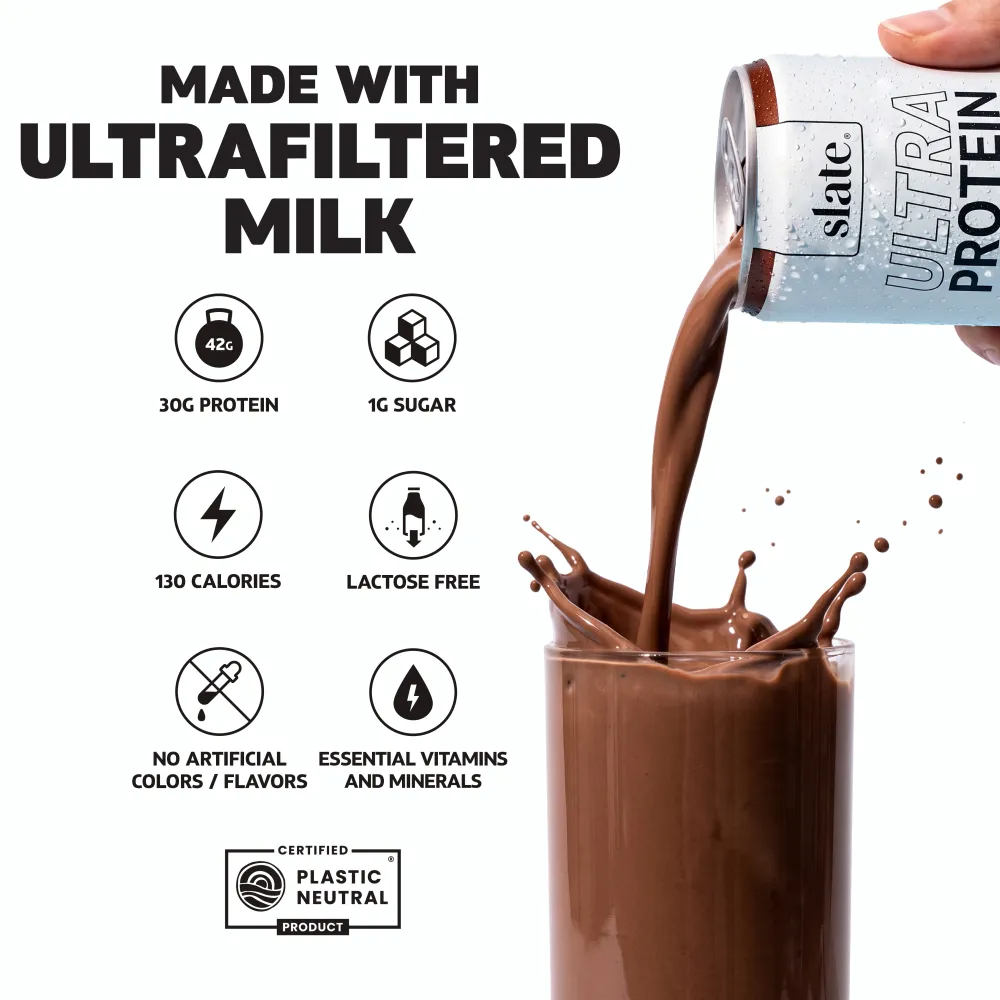
Ultrafiltered skim milk does most of the work in this can. The label lists it as a blend of ultrafiltered milk and water. Slate doesn't print how much goes in, but it's the only real protein source on the ingredient list, so almost all of the 30g on the panel comes from here. Ultrafiltration pushes milk through a membrane that holds back the proteins while letting lactose, water, and some soluble minerals pass through. The result has more protein and less lactose.[1,2] How much calcium and other minerals stay in the milk depends on the processing conditions.[3,4]
Milk protein is mostly casein with a smaller share of whey. Typical bovine milk protein ingredients run about 80:20.[5] Concentrating that protein also changes how low-fat milk feels in your mouth. In one sensory study, raising the protein in skim milk made trained tasters rate it more like higher-fat milk.[6] That helps a can with only 0.5g of fat taste fuller.
Keep your muscle expectations grounded. A trial in 30 young men compared 25g doses of different dairy proteins after resistance exercise. The fastest-absorbing version raised blood amino acids the most, but muscle protein building over four hours didn't differ between groups.[7] Those were protein preparations, not this can. The takeaway is that how fast a protein absorbs doesn't matter as much as marketing suggests.
-
Lactase Enzyme
Lactase is the enzyme your gut uses to split lactose into glucose and galactose. Many adults make less of it after childhood, a genetic trait called lactase non-persistence.[8] When lactose isn't digested, it reaches the colon and gets fermented into gas and acids. That's where the bloating, cramps, and diarrhea of lactose intolerance come from.[9]
Slate markets its products as lactose free, and ultrafiltration already removes much of the lactose. Lactase is a second layer whose job is to break down lactose. The label doesn't say how much enzyme activity it adds.
The research on treating milk with lactase looks good. In lactose-intolerant adults, enzyme-treated milk eliminated the digestive complaints and diarrhea seen with regular milk and lowered breath hydrogen,[10] and children with lactase deficiency had fewer symptoms on lactose-hydrolyzed milk than on regular milk.[11] Dose matters, though. In one controlled trial, enzyme amounts that worked against 20g of lactose barely helped against 50g.[12] Most people with lactose intolerance can also handle up to about 12-15g of lactose a day.[13]
None of this guarantees how your own gut will react, since tolerance varies from person to person. Still, using both filtration and an enzyme makes sense for a dairy drink aimed at lactose-wary buyers.
-
Vitamins and Minerals
The amounts below come from the Chocolate panel.
-
Calcium - 699mg (50% DV)
Calcium is the most underrated number on this panel. At 699mg, one can covers half the Daily Value. There's no calcium salt on the ingredient list, so it comes from the milk itself. That's a side benefit of building the drink on concentrated dairy. Calcium does its usual work here, supporting bone structure and muscle contraction.
-
Potassium (as Tripotassium Citrate) - 320mg (6% DV)
Potassium comes from two places: the milk itself and added tripotassium citrate. The 320mg on the panel is the total, and the label doesn't break it down by source. Average U.S. intake is roughly half the traditional 4,700mg/day goal,[14] so the extra is welcome. It also puts this can's potassium a little above its sodium. In population data, the sodium-to-potassium ratio tracked blood pressure more closely than either mineral alone.[15]
-
Sodium - 280mg (12% DV)
Sodium comes partly from the milk and partly from added salt, which appears right after the cocoa on the ingredient list. The total is 280mg, or 12% of the Daily Value. Salt does more than make things taste salty. Research on taste mixtures shows it suppresses bitterness,[16] which helps in a drink built on concentrated milk protein and high-intensity sweeteners.
-
Vitamin D3 - 5mcg (200 IU, 25% DV)
Vitamin D3 comes in at 5mcg (200 IU), a quarter of the Daily Value. That's a modest fortification dose, well below the roughly 4,000 IU/day adult upper limit.[17] Vitamin D increases calcium absorption,[18] so it fits a can this high in calcium. Don't expect much more from it, though. In the large VITAL trial, 2,000 IU/day didn't reduce fractures in midlife and older adults.[19]
-
Vitamin A Palmitate - 219mcg (25% DV)
Vitamin A palmitate is the one ingredient we'd like to see removed. It's preformed vitamin A, which builds up in the liver, and intake of preformed vitamin A already often exceeds the RDA in developed countries.[20] In an autopsy study of 27 U.S. adults, a third met the study's liver-based definition of vitamin A excess. The authors also said the long-term effect of supplements and fortified foods on vitamin A status is unknown.[21] The sample was small, but the finding isn't reassuring. This can's 219mcg is well under the 3,000mcg/day adult upper limit,[22] but it adds to everything else you eat. For anyone who isn't malnourished, a protein shake has no good reason to include it.
-
-
Sweeteners and Flavors
-
Sucralose
Sucralose is a chlorinated derivative of sugar that's about 600 times sweeter than sugar,[23] so a small amount goes a long way. The label doesn't disclose how much is used. EFSA re-evaluated sucralose in 2026 and kept its acceptable daily intake at 15mg/kg body weight.[24] The open question is how individuals respond. In a 2022 trial of 120 adults, two weeks of sucralose changed gut microbes and worsened glucose tolerance test results. Fasting glucose and HbA1c didn't change.[25]
-
Stevia Leaf (Reb M)
The label lists stevia leaf (Reb M), which means rebaudioside M. It's a highly glycosylated steviol glycoside with a cleaner, more sugar-like sweetness than older stevia extracts.[26] In a 126-person consumer test, Reb M's sweetness and bitterness came out closer to sugar's than Reb A's did, although its sweetness still lingered longer than sucrose.[27] EFSA reviewed Reb M made by fermentation and found no safety concern at the proposed uses.[28] The amount in this can isn't disclosed.
-
Natural Flavors
Natural flavors start the label's "less than 2%" section, along with everything listed after them. U.S. rules define a natural flavor by its source, such as plants, dairy, or fermentation, rather than by its chemistry. That means a natural and an artificial version of the same flavor molecule can be chemically identical.[29] Slate doesn't say what goes into this blend.
-
Cocoa (Processed with Alkali)
Cocoa (processed with alkali) gives the Chocolate can its flavor. Alkalizing, also called Dutch processing, lowers cocoa's acidity and darkens its color. The amount isn't disclosed, and this ingredient is specific to the Chocolate label.
-
-
Other Ingredients
- Water - The label lists it inside the ultrafiltered skim milk blend, so it's part of the milk base rather than a separate addition.
- Pectin - A plant fiber widely used to thicken and stabilize foods and drinks. The amount here is small and undisclosed, so the gram-level pectin research doesn't apply to this can.
- Cellulose gel - Another name for microcrystalline cellulose, an insoluble plant cellulose that helps keep particles suspended. In a lab test of a vitamin-fortified protein beverage, it kept the drink stable in storage better than carrageenan or cellulose gum.[30]
- Cellulose gum - Carboxymethyl cellulose, a thickener that shapes the texture of protein drinks.[31] In controlled feeding studies, 15g/day and 2.75g/day of it changed gut bacteria and their byproducts without raising measured inflammation markers, and the amount in this can isn't disclosed.[32,33]
Slate's Protein Ladder
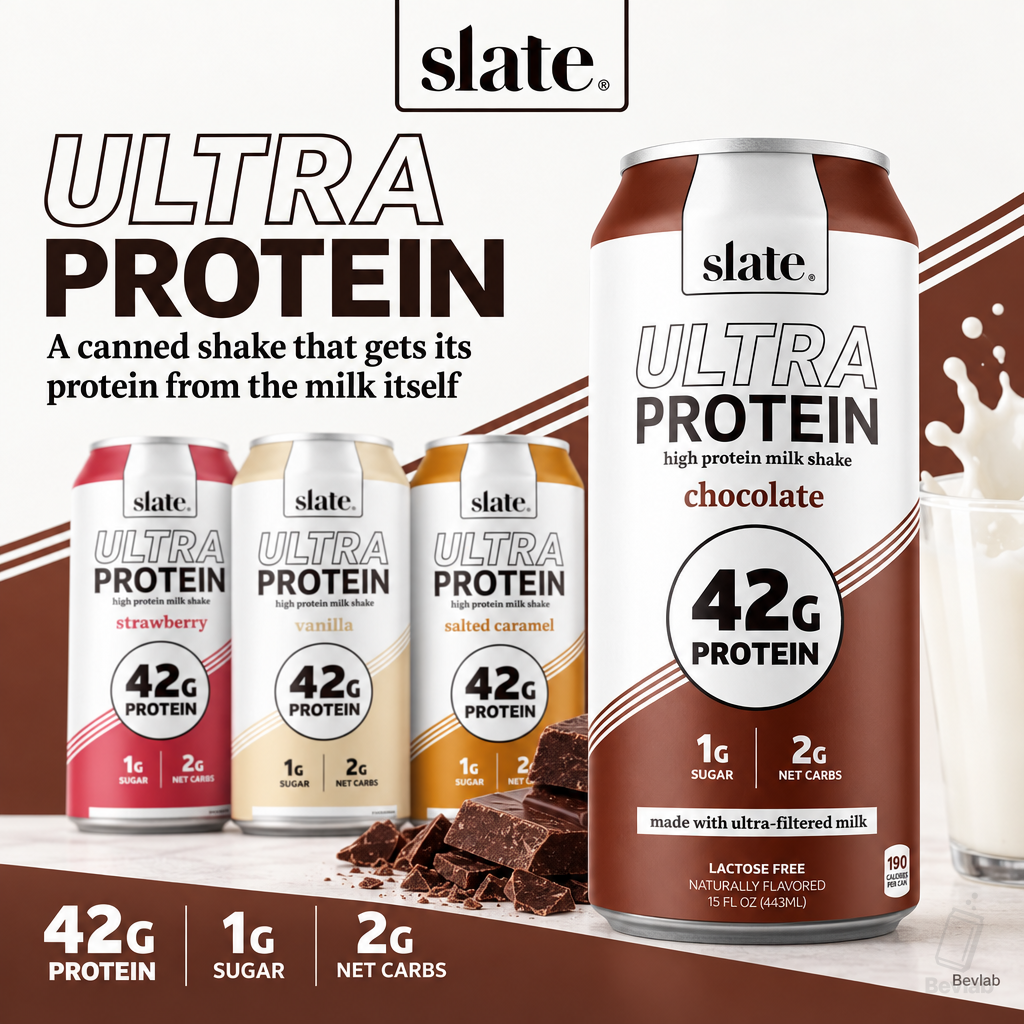
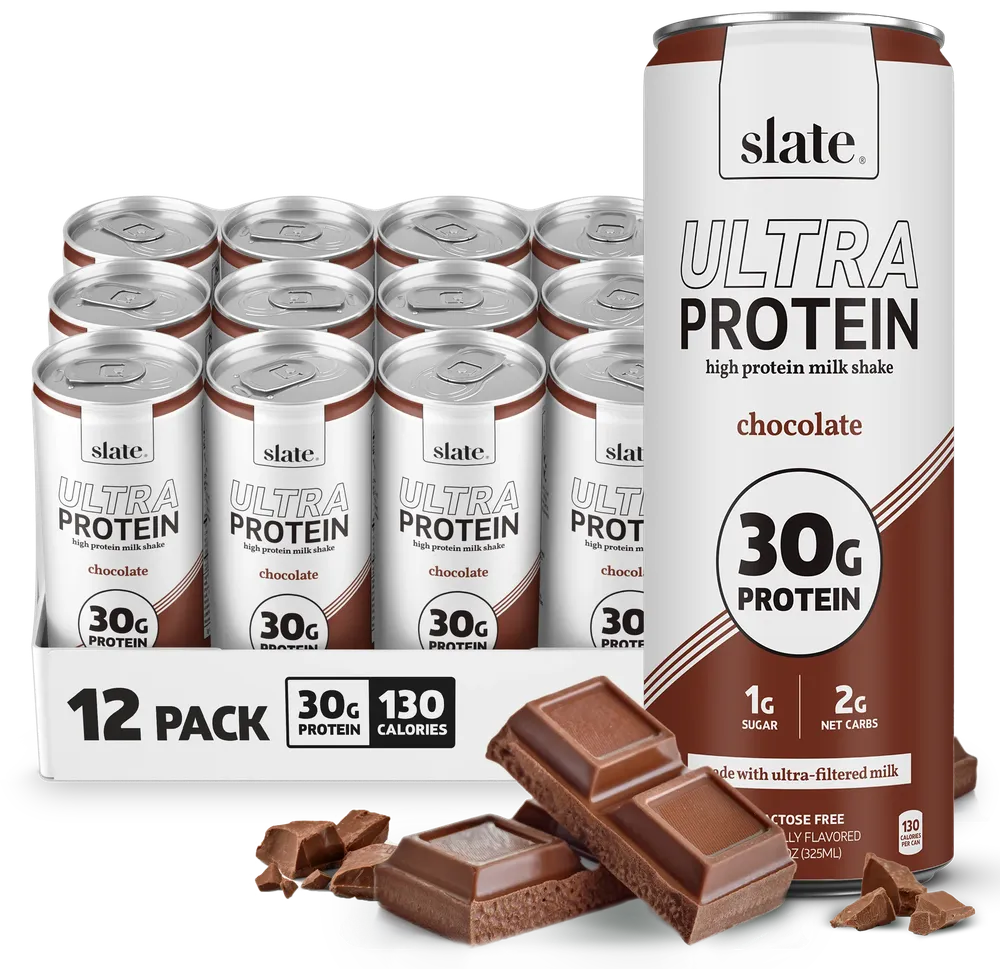
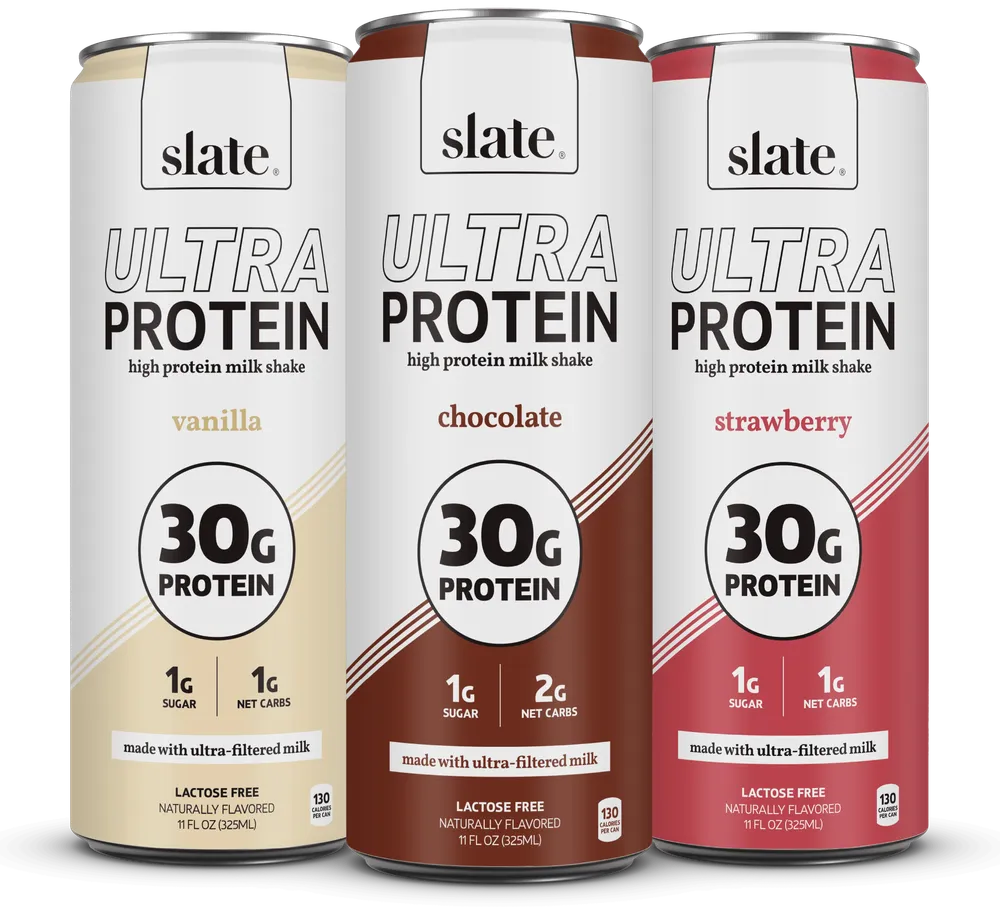
Slate's lineup works like a ladder. The 20g Protein Milk Shakes and 20g Protein Iced Coffees are the bottom rung. The 42g Ultra is at the top in a 15 fl oz can, and this 30g Ultra sits in the middle. Across the range, Slate makes the same core promises: lots of protein, 0g added sugar, and lactose free.
There's one difference worth noting. Slate only calls its 20g shakes and iced coffees all-natural. The Ultra 30g can says "naturally flavored," but it uses sucralose, so the all-natural label doesn't apply. If sucralose is a dealbreaker for you, check the 20g labels first. Slate also says its cans are recyclable aluminum and calls itself a Certified Plastic Neutral company. Because the drinks don't need refrigeration, this one works as a gym-bag or desk-drawer protein option, although Slate recommends drinking it cold.
Two Flavors, One Milk Base
Chocolate and Cookies & Cream share the same 30g protein and 1g sugar. The cocoa on the ingredient list belongs to the Chocolate can, so check the Cookies & Cream label for its exact numbers.
- Chocolate (4 Cans: $27.40)
- Cookies & Cream (4 Cans: $10.99)
- Salted Caramel (1 Can: $13.14)
- Strawberry (4 Cans: $10.99)
- Vanilla (4 Cans: $27.40)
- Variety Pack (12 Cans: $32.97)
Milk-First Protein, One Catch
If you want a chocolate-milk-style shake that gets 30g of protein from filtered dairy instead of a scoop of powder, with half your day's calcium included, Slate Ultra Protein 30g lives up to its pitch, and the filtration plus added lactase should suit lactose-wary drinkers. The one change we'd make is removing the vitamin A palmitate, which this shake doesn't need.
References
- Reig, Mònica, et al. "Use of Membrane Technologies in Dairy Industry: An Overview." Foods (Basel, Switzerland), 2021. https://doi.org/10.3390/foods10112768
- Hernandez, A J, et al. "Milk beverage base with lactose removed with ultrafiltration: Effect of fat and protein concentration on sensory and physical properties." Journal of dairy science, 2024. https://doi.org/10.3168/jds.2023-23715
- Vyas, H K, et al. "Process for calcium retention during skim milk ultrafiltration." Journal of dairy science, 2003. https://doi.org/10.3168/jds.S0022-0302(03)73872-7
- Puri, Ritika, et al. "Influence of Processing Temperature on Membrane Performance and Characteristics of Process Streams Generated during Ultrafiltration of Skim Milk." Foods (Basel, Switzerland), 2020. https://doi.org/10.3390/foods9111721
- Singh, R, et al. "Invited review: Shelf-stable dairy protein beverages-Scientific and technological aspects." Journal of dairy science, 2022. https://doi.org/10.3168/jds.2022-22208
- Quiñones, H J, et al. "Influence of protein standardization by ultrafiltration on the viscosity, color, and sensory properties of skim and 1% milk." Journal of dairy science, 1997. https://doi.org/10.3168/jds.S0022-0302(97)76285-4
- Chan, Alex H, et al. "The Degree of Aminoacidemia after Dairy Protein Ingestion Does Not Modulate the Postexercise Anabolic Response in Young Men: A Randomized Controlled Trial." The Journal of nutrition, 2019. https://doi.org/10.1093/jn/nxz099
- Anguita-Ruiz, Augusto, et al. "Genetics of Lactose Intolerance: An Updated Review and Online Interactive World Maps of Phenotype and Genotype Frequencies." Nutrients, 2020. https://doi.org/10.3390/nu12092689
- Catanzaro, Roberto, et al. "Lactose intolerance: An update on its pathogenesis, diagnosis, and treatment." Nutrition research (New York, N.Y.), 2021. https://doi.org/10.1016/j.nutres.2021.02.003
- Nagy, L, et al. "Efficacy testing of beta-galactosidase with H2 breath test in patients with carbohydrate malabsorption." Acta medica Hungarica, 1987. https://pubmed.ncbi.nlm.nih.gov/3118327/
- Nielsen, O H, et al. "Calcium absorption and acceptance of low-lactose milk among children with primary lactase deficiency." Journal of pediatric gastroenterology and nutrition, 1984. https://doi.org/10.1097/00005176-198403000-00009
- Lin, M Y, et al. "Comparative effects of exogenous lactase (beta-galactosidase) preparations on in vivo lactose digestion." Digestive diseases and sciences, 1993. https://doi.org/10.1007/BF01297079
- Borralho, Ana Isabel, et al. "Lactose Intolerance and Malabsorption Revisited: Exploring the Impact and Solutions." GE Portuguese journal of gastroenterology, 2025. https://doi.org/10.1159/000545923
- Weaver, Connie M. "Potassium and health." Advances in nutrition (Bethesda, Md.), 2013. https://doi.org/10.3945/an.112.003533
- Khaw, K T, et al. "The association between blood pressure, age, and dietary sodium and potassium: a population study." Circulation, 1988. https://doi.org/10.1161/01.CIR.77.1.53
- Breslin, P A, et al. "Salt enhances flavour by suppressing bitterness." Nature, 1997. https://doi.org/10.1038/42388
- Rizzoli, René. "Vitamin D Supplementation Upper Limit For Safety Revisited." Aging clinical and experimental research, 2021. https://doi.org/10.1007/s40520-020-01678-x
- Aloia, John F, et al. "Vitamin D Supplementation Increases Calcium Absorption Without A Threshold Effect Complete." The American journal of clinical nutrition, 2014. https://doi.org/10.3945/ajcn.113.067199
- LeBoff, Meryl S, et al. "Supplemental Vitamin D And Incident Fractures In Midlife And Older Adults." The New England journal of medicine, 2022. https://doi.org/10.1056/NEJMoa2202106
- Penniston, Kristina L, et al. "The acute and chronic toxic effects of vitamin A." The American journal of clinical nutrition, 2006. https://doi.org/10.1093/ajcn/83.2.191
- Olsen, Kiersten, et al. "Serum retinyl esters are positively correlated with analyzed total liver vitamin A reserves collected from US adults at time of death." The American journal of clinical nutrition, 2018. https://doi.org/10.1093/ajcn/nqy190
- EFSA Panel on Nutrition, Novel Foods and Food Allergens (NDA), et al. "Scientific opinion on the tolerable upper intake level for preformed vitamin A and β-carotene." EFSA journal. European Food Safety Authority, 2024. https://doi.org/10.2903/j.efsa.2024.8814
- Bourguignon, Léa, et al. "Sucralose as a Way to Enhance Regulatory T Cells, the SWEET Trial: Clinical Research Protocol." Canadian journal of kidney health and disease, 2026. https://doi.org/10.1177/20543581261418540
- EFSA, Panel on Food Additives and Flavourings (FAF), et al. "Re-evaluation of sucralose (E 955) as a food additive and evaluation of a new application on extension of use of sucralose (E 955) in fine bakery wares." EFSA journal. European Food Safety Authority, 2026. https://doi.org/10.2903/j.efsa.2026.9854
- Suez, Jotham, et al. "Personalized microbiome-driven effects of non-nutritive sweeteners on human glucose tolerance." Cell, 2022. https://doi.org/10.1016/j.cell.2022.07.016
- Prakash, Indra, et al. "Development Of Next Generation Stevia Sweetener Rebaudioside M." Foods (Basel, Switzerland), 2014. https://doi.org/10.3390/foods3010162
- Tao, Ran, et al. "Consumer-Based Sensory Characterization of Steviol Glycosides (Rebaudioside A, D, and M)." Foods (Basel, Switzerland), 2020. https://doi.org/10.3390/foods9081026
- EFSA, Panel on Food Additives and Flavourings (FAF), et al. "Safety evaluation of the food additive steviol glycosides, predominantly Rebaudioside M, produced by fermentation using Yarrowia lipolyticaVRM." EFSA journal. European Food Safety Authority, 2023. https://doi.org/10.2903/j.efsa.2023.8387
- Goodman, Matthew J. "The “Natural” vs. “Natural Flavors” Conflict in Food Labeling: A Regulatory Viewpoint." Food and drug law journal, 2017. https://pubmed.ncbi.nlm.nih.gov/29140655/
- Li, Jiaxin, et al. "Enhancing Stability of Vitamin-Fortified Protein Beverages: Optimization of Stabilizer Type and Concentration and Screening of Natural Antioxidant Combinations." Foods (Basel, Switzerland), 2026. https://doi.org/10.3390/foods15081392
- Liu, Jing, et al. "Stabilization of directly acidified protein drinks by single and mixed hydrocolloids-combining particle size, rheology, tribology, and sensory data." Food science & nutrition, 2020. https://doi.org/10.1002/fsn3.1933
- Chassaing, Benoit, et al. "Randomized Controlled-Feeding Study of Dietary Emulsifier Carboxymethylcellulose Reveals Detrimental Impacts on the Gut Microbiota and Metabolome." Gastroenterology, 2022. https://doi.org/10.1053/j.gastro.2021.11.006
- Wellens, Judith, et al. "Effect of Five Dietary Emulsifiers on Inflammation, Permeability, and the Gut Microbiome: A Placebo-controlled Randomized Trial." Clinical gastroenterology and hepatology : the official clinical practice journal of the American Gastroenterological Association, 2026. https://doi.org/10.1016/j.cgh.2025.08.005
Tagged