Caffeine for Sprinters: 3 vs 6 mg/kg Tested in Trained 100m Runners
A crossover trial in 21 trained male 100m sprinters found both caffeine doses sped up 60m times, with the higher dose adding gains only on some measures.
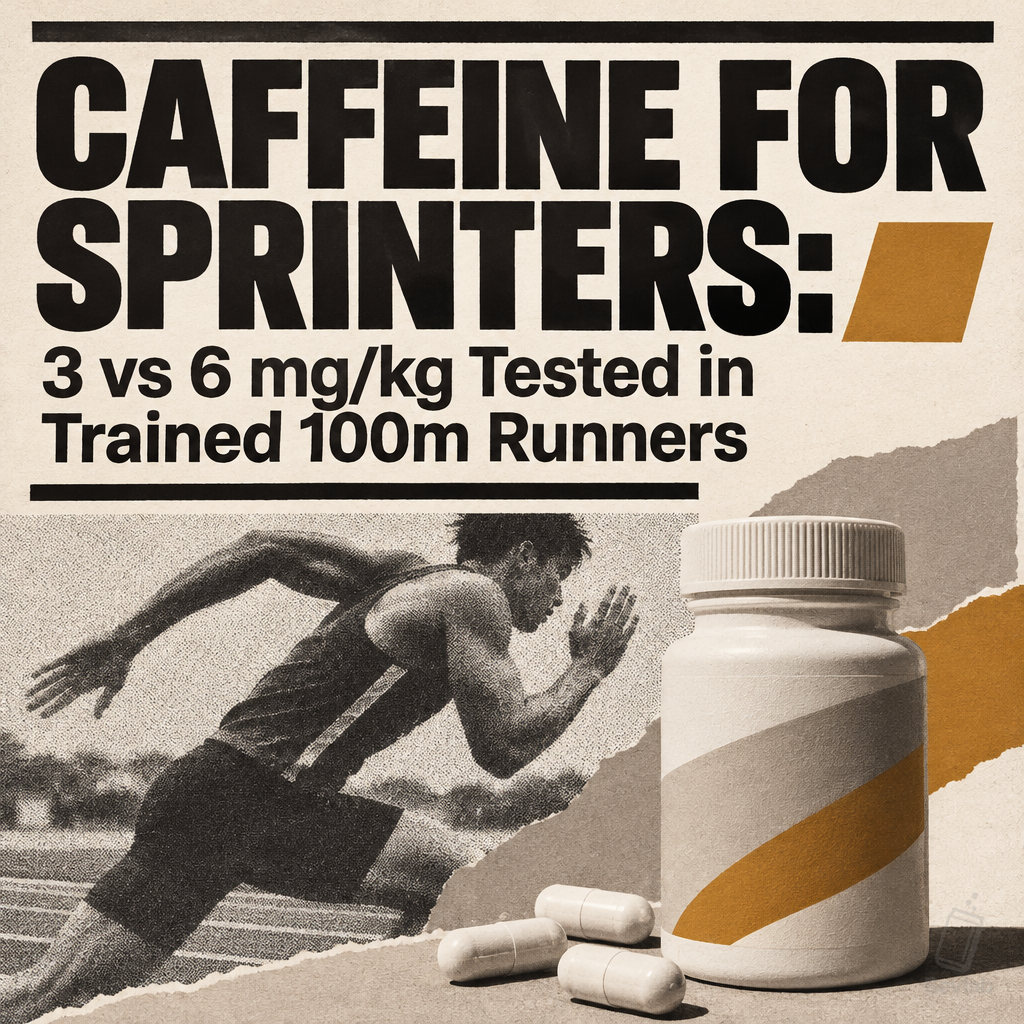
A new trial in PLoS One gave 21 trained male 100m sprinters caffeine capsules an hour before a sprint session. Both doses tested made them faster over 60m, but more caffeine didn't help across the board. The higher dose added a little more on some measures and nothing on others.[1]
The study, from researchers at Beijing Sport University, compared placebo, 3mg/kg, and 6mg/kg of caffeine. Each athlete completed all three conditions, at least seven days apart.[1]
The Doses in Energy Drink Terms
Body-weight dosing makes the numbers hard to picture, so here's a 70kg (154lb) person as an example:
- 3mg/kg works out to about 210mg of caffeine, roughly one 200mg energy drink.
- 6mg/kg works out to about 420mg, more than two of those cans and over the FDA's 400mg daily reference for healthy adults.
The study used caffeine capsules swallowed with water, not drinks. These numbers only show where the doses would sit on a shelf.
Faster on Both Doses
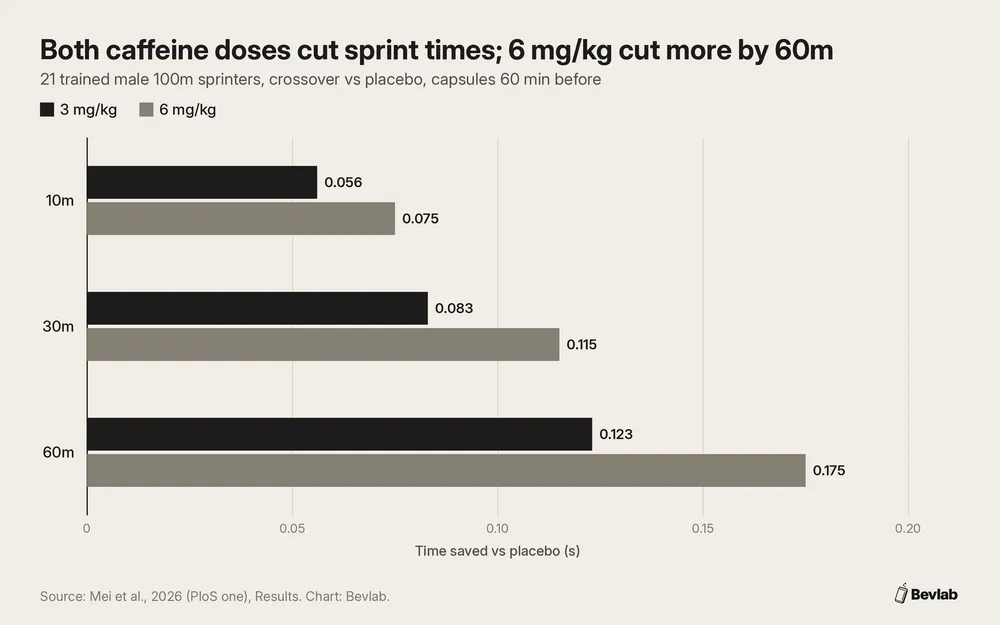
Compared with placebo, 3mg/kg cut 10m, 30m, and 60m times by 0.056, 0.083, and 0.123 seconds. At 6mg/kg, the cuts were 0.075, 0.115, and 0.175 seconds.[1] Over 60m, that's about 1.7% faster at the lower dose and 2.4% faster at the higher one. Twenty of 21 sprinters ran faster on 3mg/kg than on placebo, and all 21 ran faster on 6mg/kg.[1]
Both doses also:
- Shortened reaction time to the start signal by about 17 to 19ms.
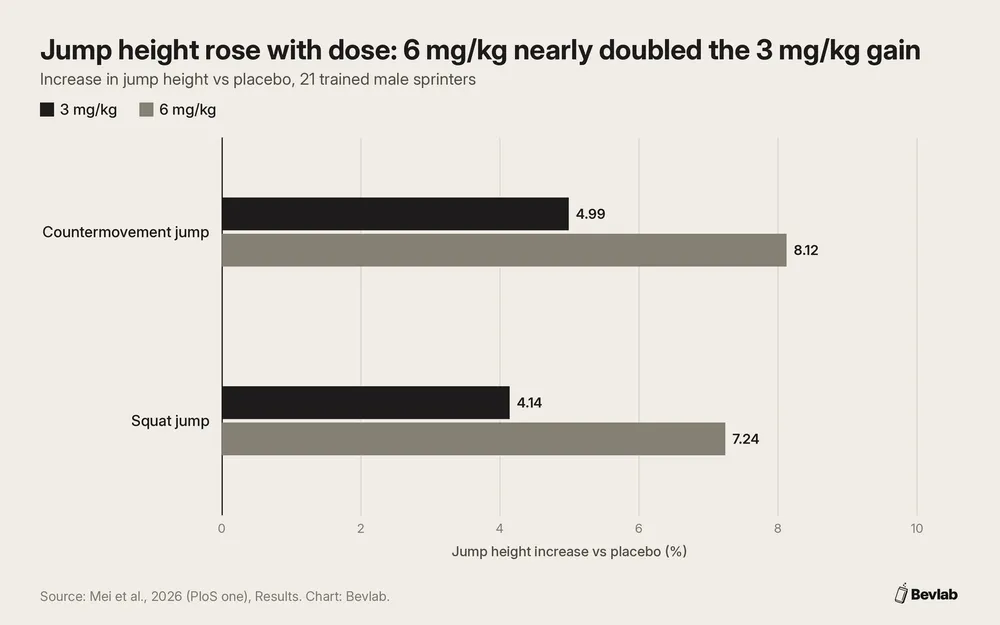
- Raised countermovement jump height (the standard dip-and-jump) by about 5% at 3mg/kg and 8% at 6mg/kg.
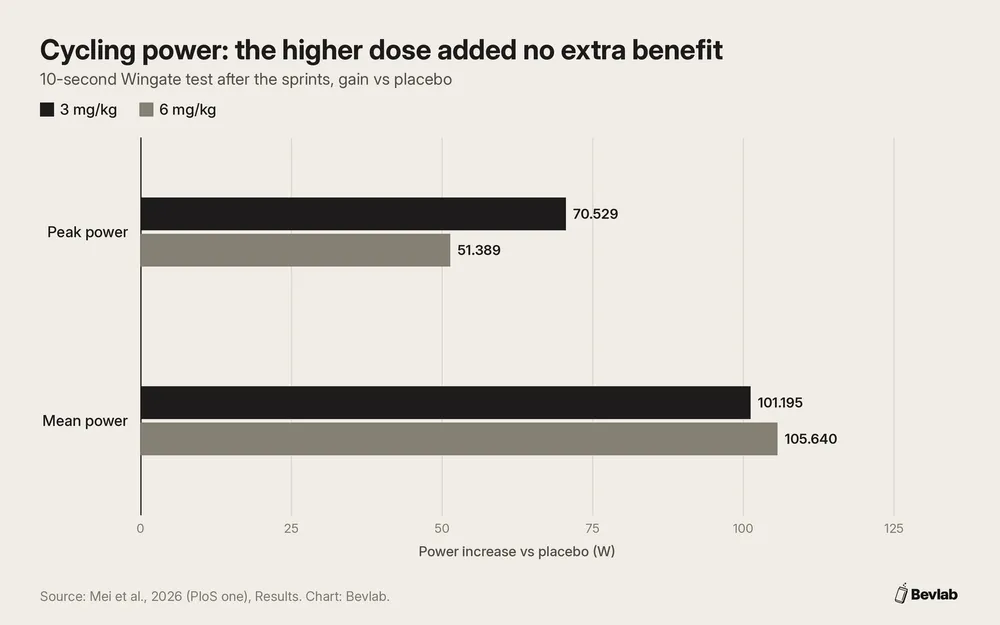
- Increased peak and average power on a 10-second all-out cycling test.
- Made the athletes rate the 60m sprint as feeling easier.
- Increased how quickly the sprinters built force against the starting blocks.[1]
Where 6mg/kg Pulled Ahead
The higher dose beat 3mg/kg on cumulative 30m time (0.032 seconds faster) and 60m time (0.052 seconds faster). It also gave higher jumps on both jump tests and faster force buildup on the blocks.[1]
The phase-by-phase picture is less clear-cut. Over the first 10m, 6mg/kg was 0.019 seconds faster than 3mg/kg, but that gap wasn't statistically significant. In the 10-30m and 30-60m segments, both doses beat placebo, but neither beat the other.[1] The researchers concluded that the higher dose's 60m edge built up over the whole run, not in one segment. The 3mg/kg result for the 30-60m segment also didn't hold up in a backup analysis, so the authors treated it cautiously.[1]
Where More Caffeine Added Nothing
Reaction time, perceived effort, and average cycling power were about the same at 3mg/kg and 6mg/kg. Peak cycling power came out numerically higher at 3mg/kg, and the authors read that as no added benefit from the higher dose, not proof that less is better.[1] Neither dose changed stride length or stride frequency over the first 10m.[1]
The authors summed it up as dose responses that depend on the outcome. A 3mg/kg dose improved several measures, and 6mg/kg added gains only for some of them.
How the Trial Worked
The athletes were 18 to 25 years old, had at least three years of systematic sprint training, and met China's national second-class 100m standard. They avoided coffee, tea, energy drinks, cola, and chocolate for 48 hours before each session. After ingestion they waited 60 minutes, ran two all-out 60m sprints, and then did the jump and cycling tests in a fixed order.[1] Neither the athletes nor the testing staff knew which capsule was which.
Side Effects Weren't Measured
The researchers didn't systematically collect side effect or tolerability data. They point out that higher caffeine doses raise the odds of insomnia, nervousness, and palpitations, and that caffeine late in the day can disrupt sleep.[1] So the study shows how the two doses affected performance, not whether 6mg/kg's extra benefit is worth its risks.
Limits Worth Knowing
The sample was small and set by how many eligible athletes were available, with no formal power calculation. All participants were trained men, and each dose was a single acute serving. Testing stopped at 60m, so the study says nothing about the final 40m of a 100m race. The jump and cycling tests came right after the sprints, so fatigue may have affected them.[1] The athletes' usual caffeine intake was recorded but not analyzed, and blood caffeine levels weren't measured.
It adds to an earlier study we covered, where one pre-exercise caffeine dose kept repeated-sprint benefits going for up to 3.5 hours.
For trained sprinters, one 200mg-class can's worth of caffeine an hour out covered most of the benefit here. Going over 400mg bought a few hundredths of a second over 60m and higher jumps, with side effects that nobody measured.
References
- Mei, T., Li, J., Yang, X. "Acute doses of 3 and 6 mg/kg caffeine produce outcome- and phase-specific improvements in male 100-m sprinters: A randomized, double-blind, placebo-controlled crossover trial." PLoS One, 2026. https://journals.plos.org/plosone/article?id=10.1371/journal.pone.0361864
Tagged