Bucked Up Big Game Energy Drink: Is it Here to Stay?
A gaming-energy oddity with a reworked formula and a habit of disappearing from shelves.
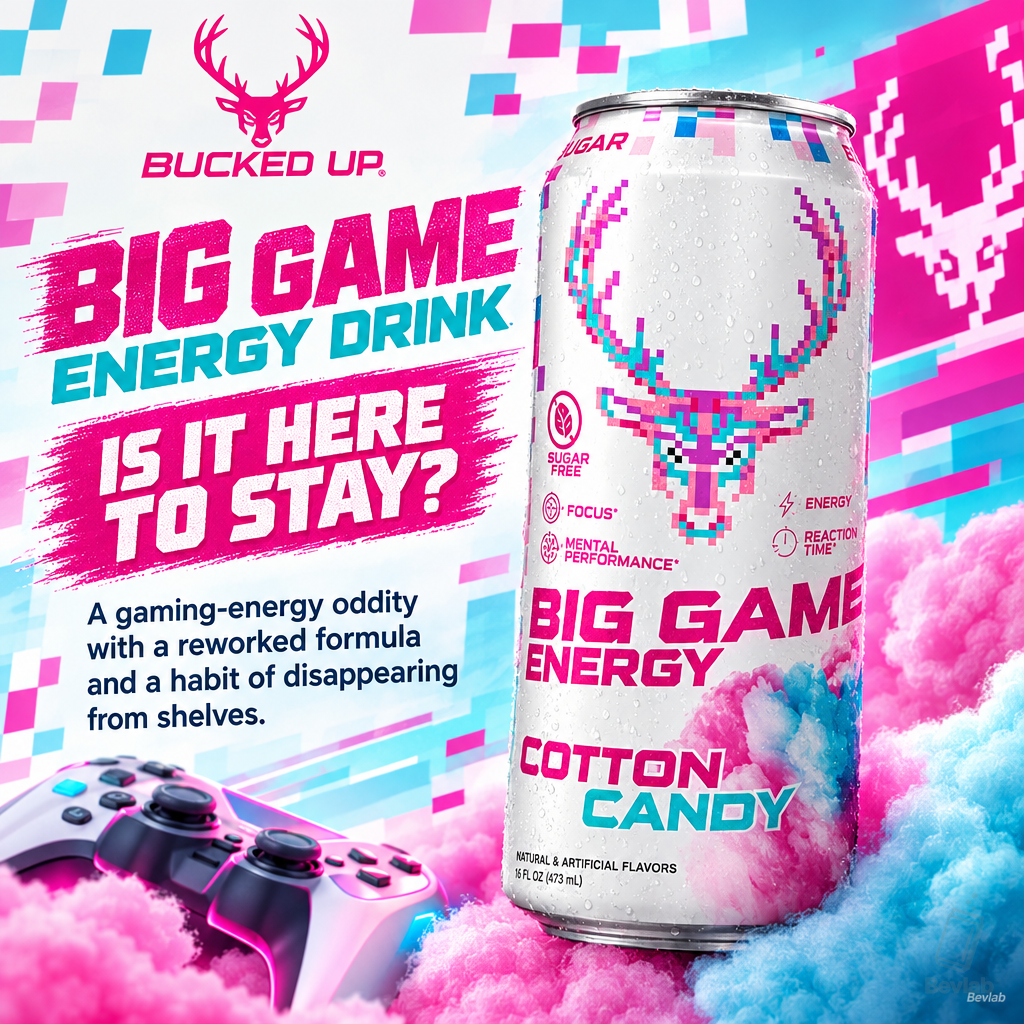
Bucked Up's Big Game Energy Drink dropped its original nooLVL gaming stack for taurine, L-carnitine, and huge B-vitamin doses.
Most gaming-branded supplements stick to powders. Bucked Up Big Game Energy Drink is the ready-to-drink version of that pitch, a subline Bucked Up spun off in 2022 alongside a Big Game Energy gaming powder that leaned hard on various nootropic ingredients. The can hasn't stuck to a predictable shelf life since. It's popped up, gone quiet, and resurfaced repeatedly at Dollar Tree and other discount retailers over the past few years, often with a flavor lineup that doesn't quite match what launched originally.
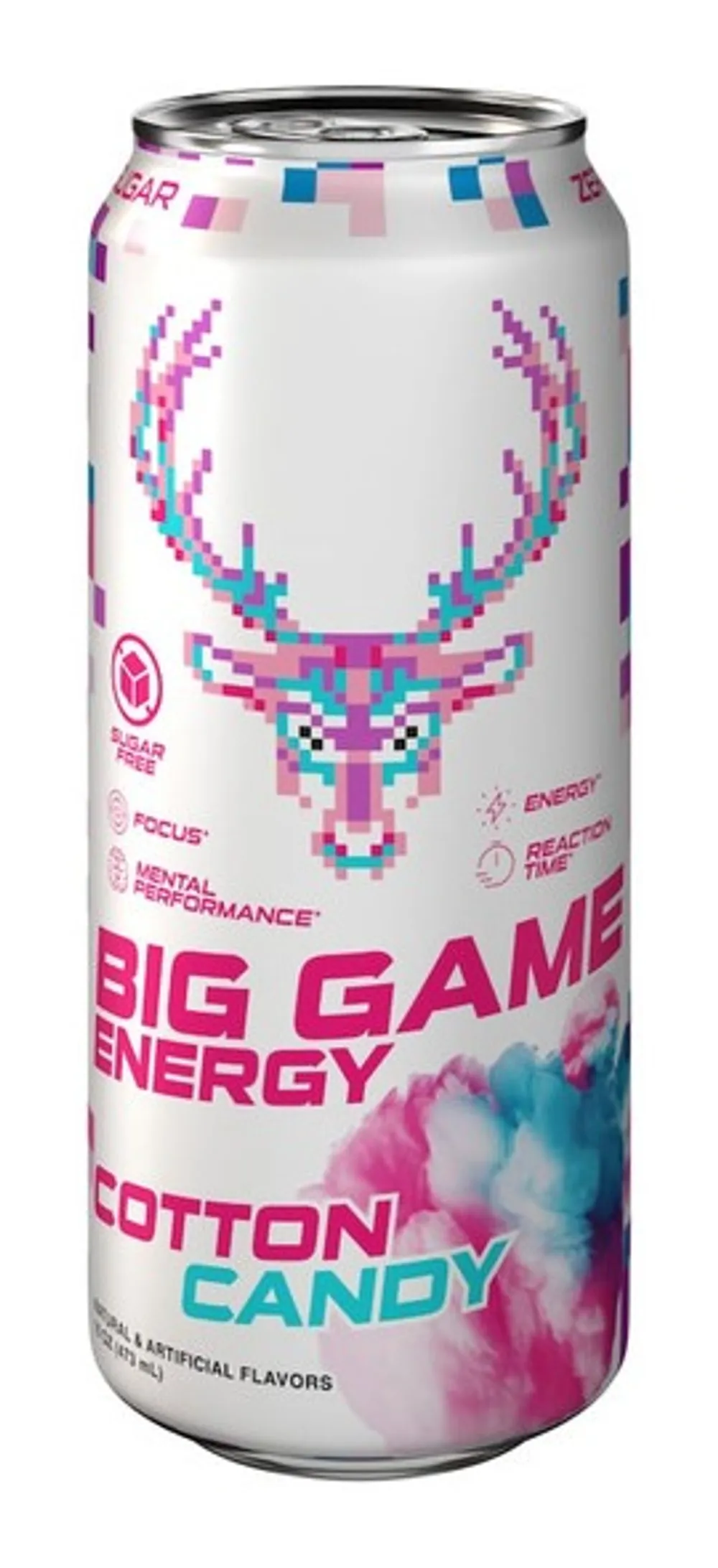
The label we pulled for this piece, a Cotton Candy can, doesn't match the original gaming-stack formula either. There's no nooLVL, no alpha-GPC, no lutein or zeaxanthin. Instead it's a simpler build: caffeine, taurine, L-carnitine, and a set of B vitamins dosed at percentages that would look at home on a multivitamin bottle. That's the story here, a gaming energy drink that quietly changed its formula somewhere along the way and never stopped showing up in unexpected places.
Bucked Up Big Game Energy Drink Nutrition Facts
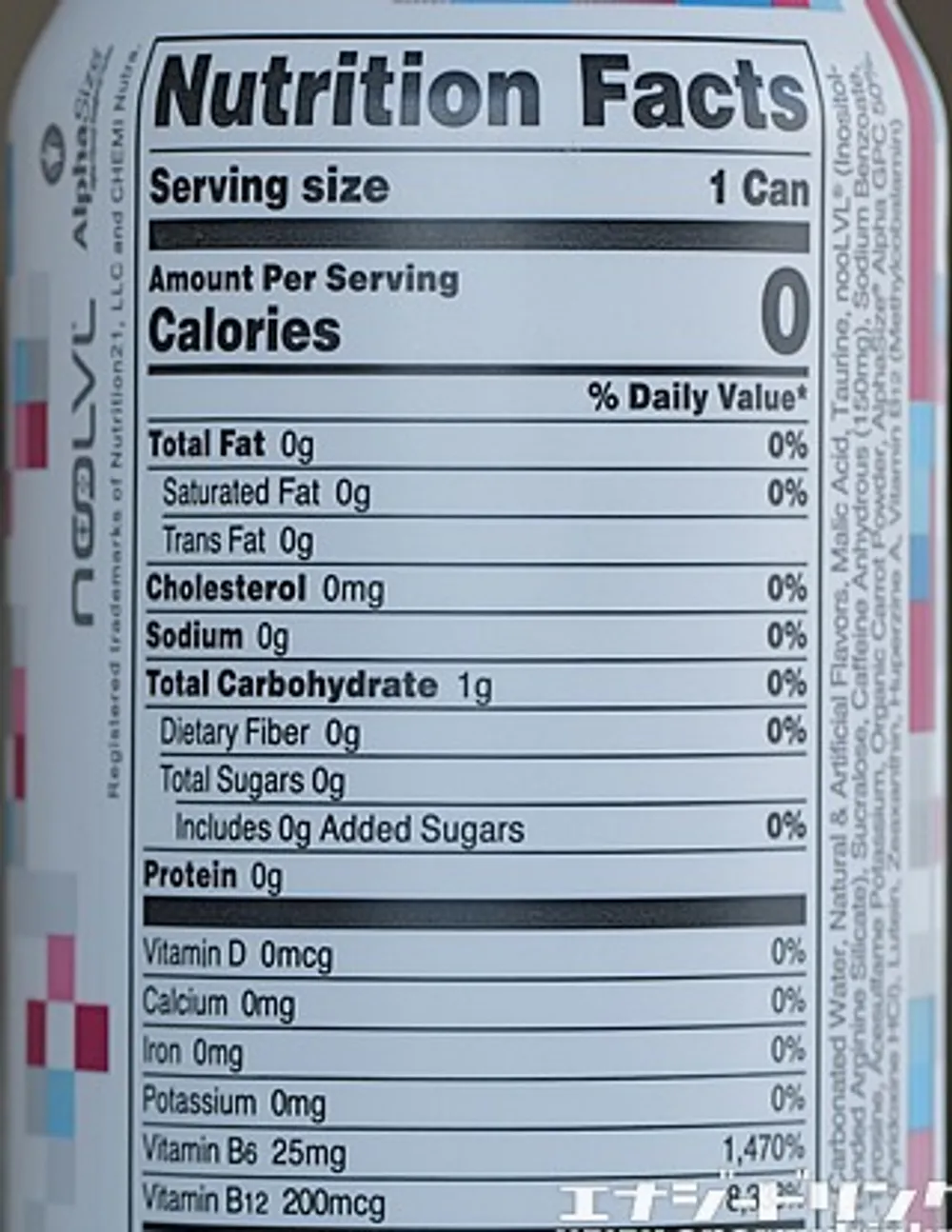
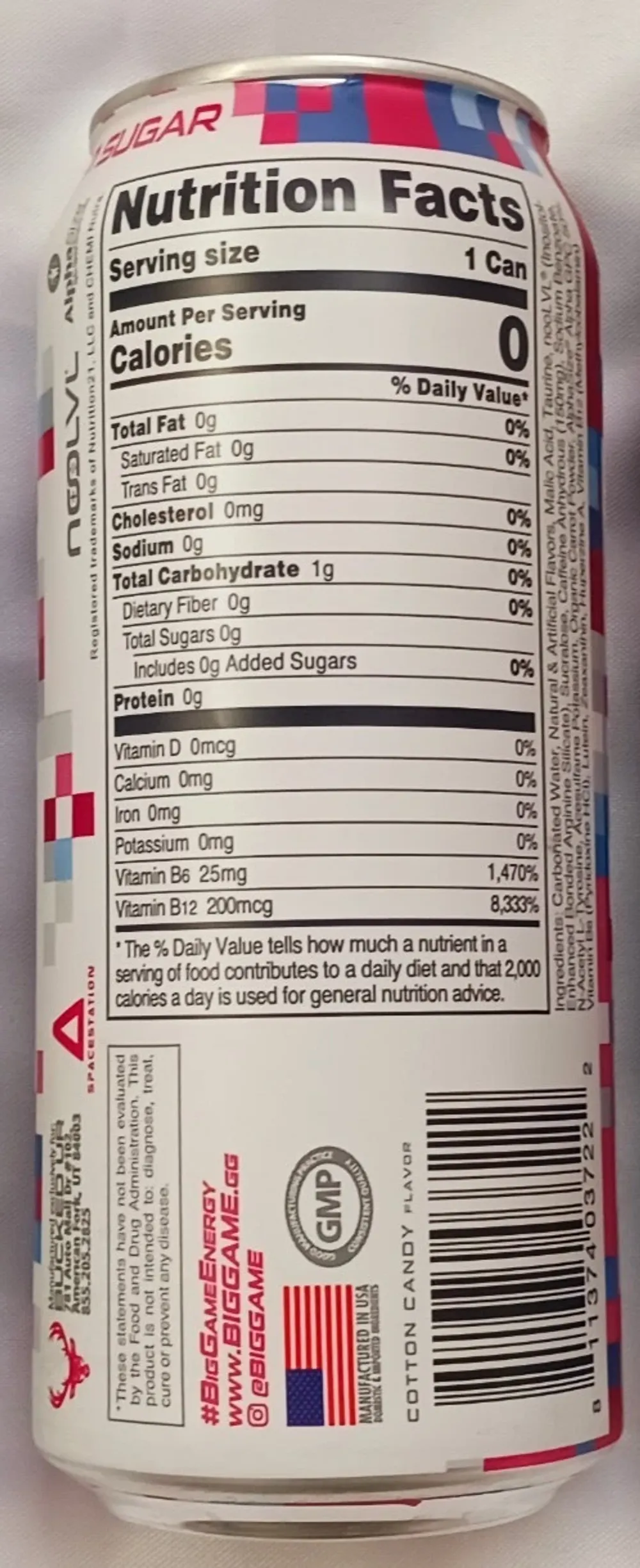
- Calories: 0
- Total Fat: 0g
- Total Carbohydrate: 1g
- Total Sugars: 0g
- Added Sugars: 0g
- Protein: 0g
- Vitamin B6: 25mg (1,470% DV)
- Vitamin B12: 200mcg (8,333% DV)
Zero calories, zero sugar, and "SUGAR FREE" printed right on the can. What jumps out is how far past 100% the B6 and B12 numbers run. Both are worth a closer look below.
Bucked Up Big Game Energy Drink Ingredients
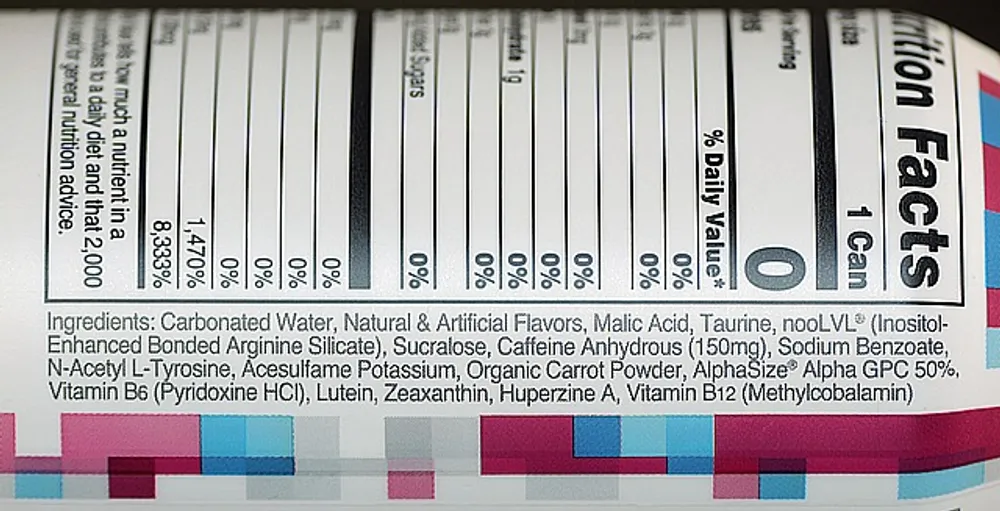
Each can lists the following ingredients, though not every one comes with a disclosed dose:
-
Caffeine (150mg?)
Caffeine is the ingredient actually doing the waking-up work, and it's the one spot where this can stays quiet. The ingredient statement lists caffeine without a milligram number, but Dollar Tree reports it as 150mg. Bucked Up's original 2022 Big Game RTD was built around a moderate 150mg per can, about half the caffeine in Bucked Up's flagship 300mg Energy line and pitched as a gaming-friendly option with less jitter. Whether the can we reviewed matches that number isn't something the label confirms.
Mechanistically, caffeine blocks the tiredness signal in your brain, which is why it reliably improves reaction time and sustained attention even at moderate doses.[1] The International Society of Sports Nutrition's position stand puts the effective range for alertness and performance at roughly 3-6mg/kg, and most healthy adults tolerate up to 400mg per day without issue.[2,3]
-
Taurine
Taurine shows up on the ingredient statement without a listed dose, so there's no way to compare this can against older Big Game labels that flagged taurine content directly on the panel. Broadly, taurine is one of the most-studied amino acids used in energy drink formulas, with a well-established safety profile at typical beverage doses.[4] The exercise research is genuinely mixed. A large meta-analysis found small-to-moderate acute performance benefits, strongest in aerobic endurance and reaction-time tasks, but the effect didn't scale up neatly with a bigger dose.[5]
Cognitive claims for taurine on its own are weaker than marketing usually suggests. A 2026 systematic review of acute human trials found taurine alone produced mostly small, inconsistent cognitive benefits, with more reliable results only when it's paired with caffeine.[6] That pairing is exactly what's happening in this can, even without a stated taurine number to work from.
-
L-Carnitine L-Tartrate
L-Carnitine L-Tartrate is a newer addition to the Big Game formula. It wasn't part of the original 2022 ingredient list, and it isn't the kind of ingredient typically associated with the nootropic-leaning gaming stack the drink launched with. LCLT is a salt form of L-carnitine frequently used in sports nutrition research, and the evidence base leans toward recovery rather than raw performance. A review of exercise studies found L-carnitine and LCLT supplementation reduced post-exercise soreness and markers of muscle damage across several controlled trials, even in cases where direct performance numbers didn't move much.[7]
Direct performance evidence is more mixed. A systematic review found no consistent benefit for moderate-intensity exercise, with more favorable results limited to specific high-intensity protocols.[8] Like caffeine and taurine, the label doesn't disclose how much L-carnitine actually made it into the can, so it's impossible to compare against the gram-level doses used in most of that research.
-
Vitamins and Minerals
-
Niacin (as Niacinamide)
Niacin appears on the label as niacinamide, the form of vitamin B3 that skips the skin-flushing reaction associated with nicotinic acid.[9] The can doesn't list a niacin dose or percent daily value, which is odd given that B6 and B12 both get full disclosure just a few lines down. Niacinamide's core job is straightforward: it's a building block for NAD+, the coenzyme cells use to convert food into usable energy.[10]
-
Vitamin B6 (as Pyridoxine Hydrochloride) - 25mg (1,470% DV)
Vitamin B6 appears as pyridoxine hydrochloride at 25mg, working out to 1,470% of the daily value. That's a big number on paper, and we do want to caution users who already get the ingredient or are sensitive to it. It sits well below the 200mg-plus daily doses used in clinical trials for nausea and other B6-specific treatments.[11] Once converted to its active coenzyme form, pyridoxal-5'-phosphate, it's the precursor behind dozens of amino acid and neurotransmitter reactions.[12] Reported neuropathy cases involve chronic daily intake well above a single can's 25mg, but stacking multiple B6-fortified products across a day adds up faster than most people expect.
-
Vitamin B12 (as Cyanocobalamin) - 200mcg (8,333% DV)
Vitamin B12 shows up as cyanocobalamin, the most stable and shelf-friendly form used in beverages, at 200mcg, or 8,333% of the daily value.[13] That number looks alarming at first, but B12 has no established upper intake limit and no confirmed direct toxicity even at very high supplemental doses, since it's water-soluble and gets excreted efficiently.[14] It's a standard, low-cost way for an energy drink to check the vitamins box.
-
-
Other Ingredients
- Carbonated Water is the beverage base, providing carbonation and mouthfeel with no caloric contribution.
- Natural & Artificial Flavors cover the Cotton Candy taste profile on the can we reviewed.
- Malic Acid and Citric Acid provide the tartness balancing the sweetness, both common energy drink acidulants that also happen to be intermediates in the body's own citric acid cycle.
- Sucralose is the sweetener carrying the zero-sugar, zero-calorie label claim.
- Potassium Sorbate and Sodium Benzoate are standard preservatives that keep mold and yeast from growing in an acidic, shelf-stable can.
- Red 40 appears on the ingredient statement for the Cotton Candy can specifically, giving it that pink color. Other flavors in the lineup may use different colorants or none at all.
A Flavor Lineup That Comes and Goes
Big Game Energy launched in 2022 with three flavors, Cotton Candy, Sour Gummy, and Peach Passion, matching the menu of Bucked Up's original Big Game gaming powder. The drink hasn't stayed in steady national distribution since. Sightings from 2024 through 2026 place cans at Dollar Tree and other discount retailers, sometimes alongside flavors like Orange Cream, Pineapple Punch, and Wild Cherry. Whether that reflects a formal relaunch or just older inventory working its way through discount channels isn't something we can confirm, but it's part of what makes this drink an oddity worth watching for.
- Cotton Candy (12 Cans: $42.98)
Who Actually Grabs This One
- Moderate-caffeine drinkers: if the current can still lands anywhere near the original 150mg range, it sits between a standard soda and a 300mg Enny, though the label won't confirm the number for you.
- Bargain-bin hunters: Big Game Energy's habit of showing up at Dollar Tree makes it a genuine discovery item for shoppers who like finding energy drinks outside the usual convenience store rotation.
Is It Worth Grabbing If You Spot One?
Big Game Energy is worth trying if you find it, mostly because it reads different from Bucked Up's mainline Energy cans, and the current formula trades a gaming-nootropic stack for a simpler taurine, L-carnitine, and B-vitamin base. We're not 100% sure on the caffeine, but it looks like 150mg. If you spot a can at Dollar Tree, it's a low-risk way to sample a piece of Bucked Up's gaming history, just don't expect the same stack that made the original 2022 Big Game RTD stand out.
Just be careful of that vitamin B6 dose, it's a big one.
Follow @BevlabMedia on TikTok and Instagram for more oddball energy drink finds like this one.
References
- McLellan, Tom M. et al. "A Review Of Caffeine S Effects On Cognitive Physical And Occupational Performance." Neuroscience & Biobehavioral Reviews, 2016. https://doi.org/10.1016/j.neubiorev.2016.09.001
- Guest, Nanci S. et al. "International Society Of Sports Nutrition Position Stand Caffeine And Exercise Performance." Journal of the International Society of Sports Nutrition, 2021. https://doi.org/10.1186/s12970-020-00383-4
- Wikoff, Daniele, et al. "Systematic review of the potential adverse effects of caffeine consumption in healthy adults, pregnant women, adolescents, and children." Food and chemical toxicology : an international journal published for the British Industrial Biological Research Association, 2017. https://doi.org/10.1016/j.fct.2017.04.002
- Santulli, Gaetano, et al. "Functional Role of Taurine in Aging and Cardiovascular Health: An Updated Overview." Nutrients, 2023. https://doi.org/10.3390/nu15194236
- Deng, Hengzhi, et al. "Does One Shot Work? The Acute Impact of a Single Taurine Dose on Exercise Performance: A Meta-Analytic Review." Scandinavian journal of medicine & science in sports, 2025. https://doi.org/10.1111/sms.70123
- Moore, Jack A, et al. "Cognitive Effects of Taurine and Related Sulphur-Containing Amino Acids: A Systematic Review of Human Trials and Considerations for Plant-Based Dietary Transitions." Foods (Basel, Switzerland), 2026. https://doi.org/10.3390/foods15040634
- Fielding, Roger, et al. "L Carnitine Supplementation In Recovery After Exercise." Nutrients, 2018. https://doi.org/10.3390/nu10030349
- Mielgo-Ayuso, Juan, et al. "Effect Of Acute And Chronic Oral L Carnitine Supplementation On Exercise Performance Based On The Exercise Intensity A Systematic Review." Nutrients, 2021. https://doi.org/10.3390/nu13124359
- Gasperi, Valeria, et al. "Niacin In The Central Nervous System An Update Of Biological Aspects And Clinical Applications." International Journal of Molecular Sciences, 2019. https://doi.org/10.3390/ijms20040974
- Yang, Yue, et al. "Nad Metabolism Bioenergetics Signaling And Manipulation For Therapy." Biochimica et Biophysica Acta (BBA) - Proteins and Proteomics, 2016. https://doi.org/10.1016/j.bbapap.2016.06.014
- He, Ling, et al. "The potential hazards of high doses of vitamin B6 in treating nausea and vomiting in pregnancy: A systematic review." International journal of gynaecology and obstetrics: the official organ of the International Federation of Gynaecology and Obstetrics, 2025. https://doi.org/10.1002/ijgo.16032
- Kato, Norihisa, et al. "Relationship of Low Vitamin B6 Status with Sarcopenia, Frailty, and Mortality: A Narrative Review." Nutrients, 2024. https://doi.org/10.3390/nu16010177
- Paul, Cristiana, et al. "Comparative Bioavailability and Utilization of Particular Forms of B12 Supplements With Potential to Mitigate B12-related Genetic Polymorphisms." Integrative medicine (Encinitas, Calif.), 2017. https://pubmed.ncbi.nlm.nih.gov/28223907/
- Lyon, Peter, et al. "B Vitamins And One Carbon Metabolism Implications In Human Health And Disease." Nutrients, 2020. https://doi.org/10.3390/nu12092867
Tagged