Tonino Lamborghini Energy Drink - Zero Sugar
Italian supercar branding meets a zero-sugar energy can. Here's what's actually in it.
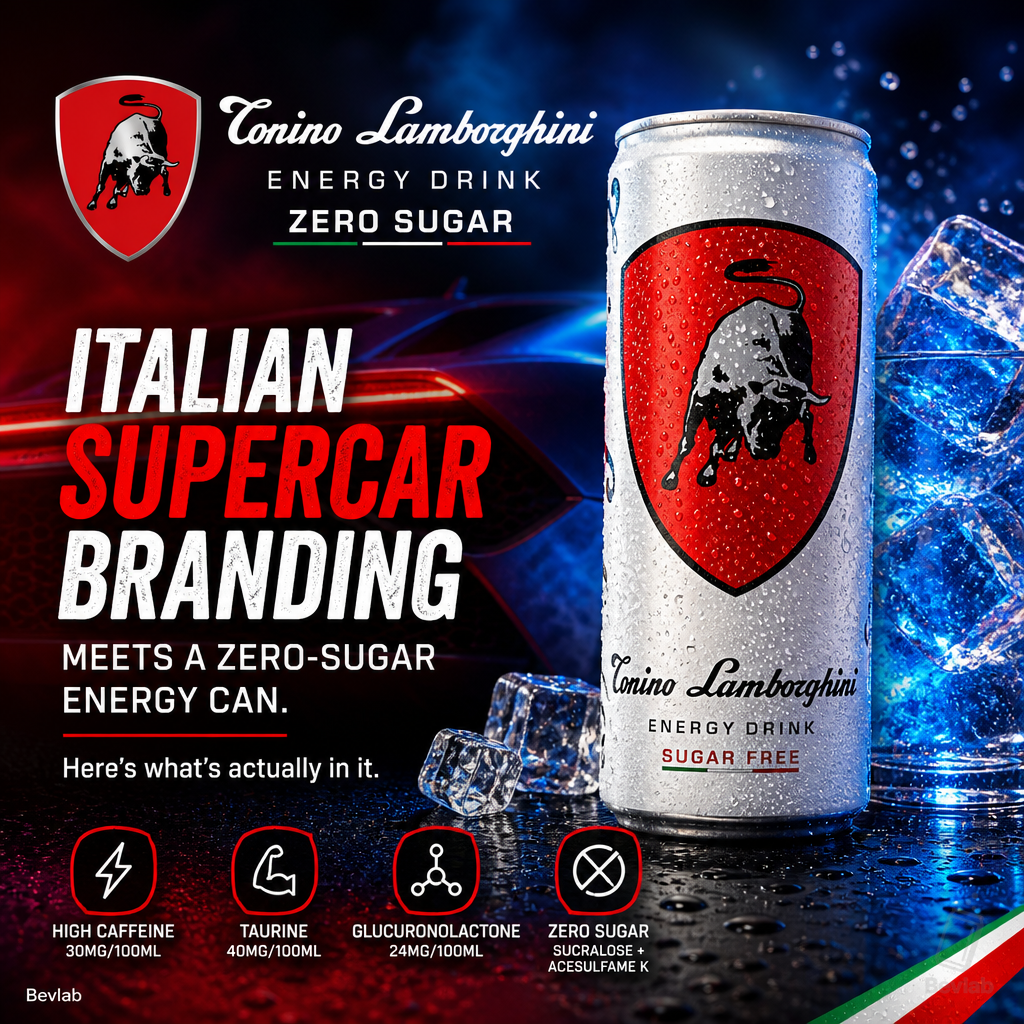
A full ingredient breakdown of Tonino Lamborghini Energy Drink Zero Sugar, covering caffeine, taurine, glucuronolactone, and the full vitamin stack.
Tonino Lamborghini Energy Drink Zero Sugar takes the brand's mixed fruit energy drink and strips out the sugar, leaning on sucralose and acesulfame potassium instead. Made in Italy by Enrico Giotti S.p.A. for Officina Gastronomica Srl, the 250mL can carries the familiar energy drink trio of caffeine, taurine, and glucuronolactone, backed by a full B-vitamin lineup. The brand has been expanding its international footprint in recent years, including a late-2025 distribution partnership with Velza that widens its reach beyond its existing markets. This breakdown covers the Zero Sugar SKU specifically.
Tonino Lamborghini Energy Drink Zero Sugar Nutrition Facts
The can's nutrition panel reports values per 100mL, not a per-can total, so we're presenting the label as written rather than guessing at a 250mL conversion.
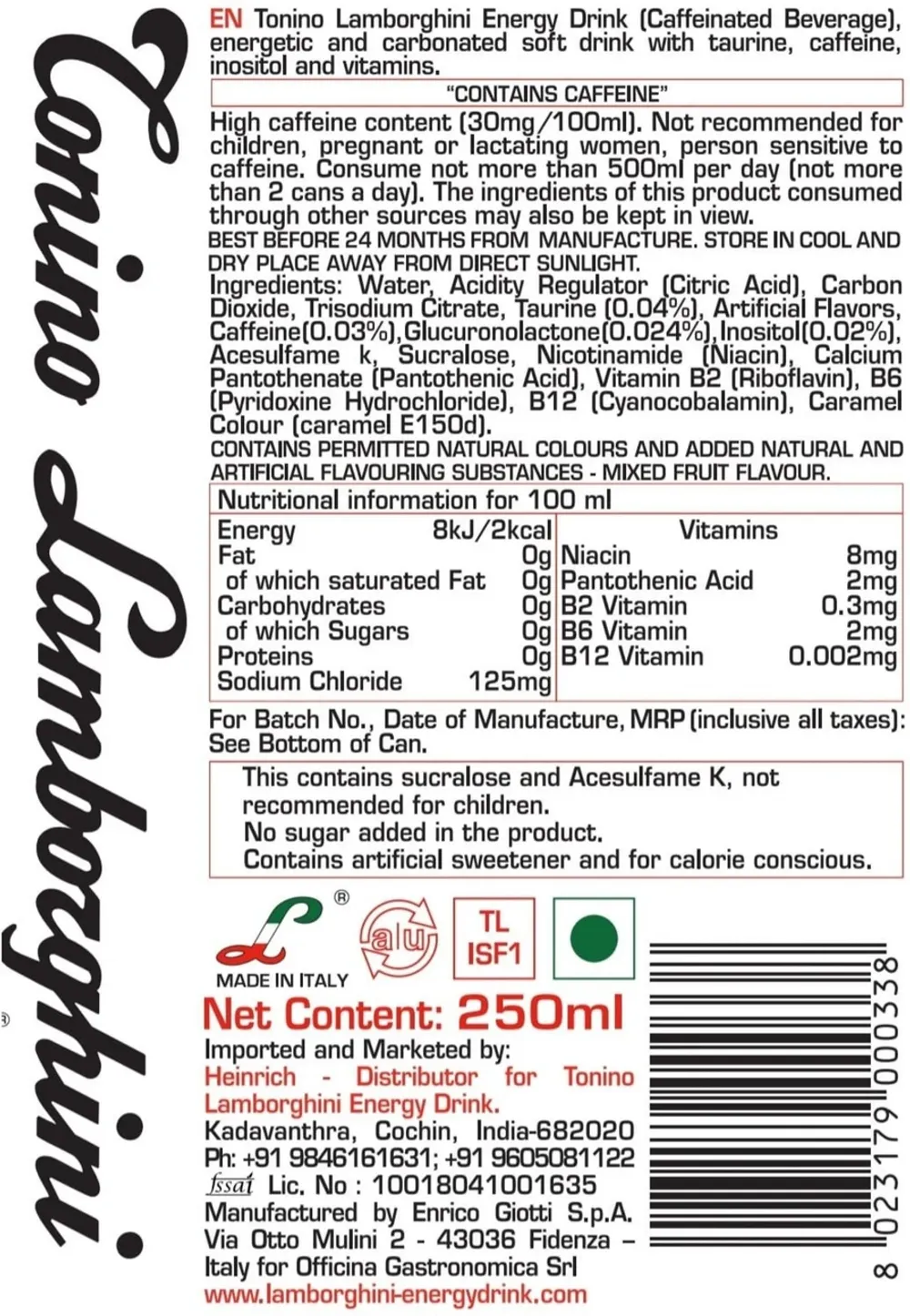
Per 100mL:
- Energy: 8kJ / 2kcal
- Total Fat: 0g
- Saturated Fat: 0g
- Total Carbohydrates: 0g
- Sugars: 0g
- Protein: 0g
- Sodium Chloride: 125mg
- Niacin: 8mg
- Pantothenic Acid: 2mg
- Vitamin B2: 0.3mg
- Vitamin B6: 2mg
- Vitamin B12: 0.002mg
No sugar is added to the formula, and the label carries the standard artificial sweetener disclosure for calorie-conscious shoppers.
Tonino Lamborghini Energy Drink Zero Sugar Ingredients
The label lists active levels as percentages rather than per-can milligram totals, so the amounts below reflect the disclosed concentrations converted to a per-100mL basis, which is how the brand reports them.
-
Caffeine - 30mg per 100mL
Caffeine is the primary stimulant here, disclosed at 0.03% on the label, which works out to 30mg per 100mL, matching the can's own "high caffeine content" warning. Mechanistically, caffeine blocks the receptors that pick up on the buildup of adenosine, the molecule your brain uses to signal that it's time to slow down.[1] That's the core mechanism behind the alertness a can like this delivers.
The dose range studied for cognitive benefits like reaction time, vigilance, and mood runs from about 32mg up to 300mg, so a full 250mL can of this Zero Sugar variant (roughly 75mg based on the label's per-100mL rate) sits comfortably in that window.[2] Caffeine is also one of the best-studied ergogenic aids for endurance exercise, with the ISSN's position stand pointing to consistent benefits at 3-6mg/kg body weight.[3] The can's own warning to cap intake at two cans (500mL) per day lines up with general safety guidance suggesting healthy adults can handle up to 400mg/day without notable adverse effects.[4]
-
Taurine - 40mg per 100mL
Taurine shows up at 0.04% on the label, or 40mg per 100mL. It's one of the most abundant amino acids in your body's excitable tissues, including the heart, muscle, and brain, and it plays into everything from calcium handling in muscle cells to antioxidant defense.[5] Most of what we know about taurine's exercise benefits comes from acute doses in the 1-6g range consumed before activity, a much higher amount than what's in a single can here.[6]
That said, taurine's strongest human evidence isn't about acute performance at all. It's cardiovascular. Meta-analyses of taurine supplementation trials, typically dosed in the 1.5-3g/day range over weeks to months, have found meaningful reductions in blood pressure, heart rate, and markers tied to metabolic syndrome.[7,8] At the levels here, taurine reads more as a category-standard inclusion alongside caffeine than a standalone therapeutic dose, since most energy drink taurine research pairs it with caffeine rather than testing it alone.[9]
-
Glucuronolactone - 24mg per 100mL
Glucuronolactone appears at 0.024%, or 24mg per 100mL, putting it in line with the roughly 2400mg/L standard that defined the original Red Bull-style energy drink formula.[10] It's a compound your liver naturally produces in small amounts as part of glucose metabolism, and at higher supplemented doses it's been studied for a role in detoxification support through inhibition of the enzyme beta-glucuronidase.[11]
Human evidence for glucuronolactone as a standalone ingredient is thin. The clearest performance data comes from multi-ingredient energy drink trials where it's impossible to separate its individual contribution from caffeine and taurine.[12] One controlled trial that isolated glucuronolactone specifically found it didn't raise blood pressure the way caffeine did, though it did produce an unexpected shortening of the heart's QTc interval, an effect the researchers flagged as needing more study.[13]
-
Inositol - 20mg per 100mL
Inositol rounds out the classic energy drink quartet at 0.02%, or 20mg per 100mL. It's a sugar alcohol your body uses to build second-messenger molecules involved in insulin, hormone, and neurotransmitter signaling.[14] Most of the clinical research on inositol uses doses in the 1-4g/day range for insulin sensitivity and metabolic support, so the amount here is far below what's been studied for those specific benefits.[15]
In an energy drink setting, inositol's inclusion is more about rounding out the traditional formula than delivering a therapeutic dose on its own. It's the same role it plays in the broader legacy energy drink formula this can is clearly modeled after.
-
Sucralose
Sucralose is one of two non-nutritive sweeteners doing the work that sugar would otherwise do, roughly 600 times sweeter than table sucrose by weight.[16] It's poorly absorbed in the gut, with the majority passing through unmetabolized, and it's approved for use worldwide under acceptable daily intake limits set well above what you'd get from typical beverage consumption.[17]
The research on sucralose's metabolic effects is mixed. Some trials have found it can modestly reduce insulin sensitivity with repeated daily exposure,[18] while a larger randomized trial found no meaningful change in fasting glucose or HbA1c after two weeks of use, though it did detect shifts in gut microbiome composition.[19] For an occasional can, these effects are unlikely to be noticeable, but it's worth knowing sucralose isn't universally inert at the microbiome level.
-
Vitamins and Minerals
-
Niacin (as Nicotinamide) - 8mg per 100mL
Niacin here is delivered as nicotinamide, the form that doesn't cause the flushing sensation associated with high-dose nicotinic acid.[20] It's essential for building NAD+, the coenzyme your cells rely on for energy production, and at 8mg per 100mL this can delivers a meaningful contribution toward typical daily niacin needs.
-
Vitamin B5 (as Calcium Pantothenate) - 2mg per 100mL
Vitamin B5, delivered as calcium pantothenate, is the building block for Coenzyme A, a molecule involved in a huge share of the body's energy-producing reactions.[21] At 2mg per 100mL, it's a standard supporting-cast B-vitamin rather than a headline ingredient here.
-
Riboflavin (as Riboflavin) - 0.3mg per 100mL
Riboflavin, or vitamin B2, is a precursor to the coenzymes FAD and FMN, which sit at the center of the mitochondrial electron transport chain.[22] The 0.3mg per 100mL here is a modest but standard inclusion for a functional beverage.
-
Vitamin B6 (as Pyridoxine Hydrochloride) - 2mg per 100mL
Vitamin B6, as pyridoxine hydrochloride, converts to pyridoxal-5'-phosphate, the active coenzyme form involved in well over a hundred enzymatic reactions, including amino acid metabolism and neurotransmitter synthesis.[23] At 2mg per 100mL, this can's B6 content stays well within typical dietary reference ranges.
-
Vitamin B12 (as Cyanocobalamin) - 0.002mg per 100mL
Vitamin B12, as cyanocobalamin, is essential for red blood cell formation and the methionine cycle. The 0.002mg (2mcg) per 100mL figure is a standard B-complex inclusion, well within the safety margin research has established for this well-tolerated vitamin.[24]
-
-
Other Ingredients
- Water - The base of the formula and the primary delivery vehicle for every other ingredient in the can.
- Carbon Dioxide - Provides the carbonation and fizz.
- Citric Acid - Used as an acidity regulator to balance the drink's tartness and support flavor stability.
- Trisodium Citrate (Sodium Citrate) - Works alongside citric acid to buffer pH and round out the tart, fruit-forward taste.
- Natural & Artificial Flavors - Deliver the can's mixed fruit flavor profile.
- Acesulfame Potassium - The second non-nutritive sweetener in the blend, typically paired with sucralose to produce a more sugar-like sweetness curve than either sweetener alone.
- Caramel Colour (E150d) - Gives the beverage its characteristic amber color.
A Quick Note on the Sugar Version
Tonino Lamborghini also sells a standard sugared Energy Drink alongside this Zero Sugar can. The two are separate SKUs with different sweetening systems, and this breakdown covers the Zero Sugar formula specifically, not the sugared original.
The Bottom Line
This is a straightforward, category-standard formula wearing a supercar badge: caffeine, taurine, glucuronolactone, and inositol at classic energy drink levels, sweetened with sucralose and acesulfame potassium instead of sugar. It's a safe, transparent play for anyone drawn to the Lamborghini name who wants a zero-sugar can without surprises.
References
- Fredholm, Bertil B. et al. "Actions of Caffeine in the Brain with Special Reference to Factors That Contribute to Its Widespread Use." Pharmacological Reviews, 1999. https://doi.org/10.1016/S0031-6997(24)01396-6
- McLellan, Tom M. et al. "A Review Of Caffeine S Effects On Cognitive Physical And Occupational Performance." Neuroscience & Biobehavioral Reviews, 2016. https://doi.org/10.1016/j.neubiorev.2016.09.001
- Guest, Nanci S. et al. "International Society Of Sports Nutrition Position Stand Caffeine And Exercise Performance." Journal of the International Society of Sports Nutrition, 2021. https://doi.org/10.1186/s12970-020-00383-4
- Wikoff, Daniele, et al. "Systematic review of the potential adverse effects of caffeine consumption in healthy adults, pregnant women, adolescents, and children." Food and chemical toxicology : an international journal published for the British Industrial Biological Research Association, 2017. https://doi.org/10.1016/j.fct.2017.04.002
- Santulli, Gaetano, et al. "Functional Role of Taurine in Aging and Cardiovascular Health: An Updated Overview." Nutrients, 2023. https://doi.org/10.3390/nu15194236
- Deng, Hengzhi, et al. "Does One Shot Work? The Acute Impact of a Single Taurine Dose on Exercise Performance: A Meta-Analytic Review." Scandinavian journal of medicine & science in sports, 2025. https://doi.org/10.1111/sms.70123
- Tzang, Chih-Chen, et al. "Insights into the cardiovascular benefits of taurine: a systematic review and meta-analysis." Nutrition journal, 2024. https://doi.org/10.1186/s12937-024-00995-5
- Tzang, Chih-Chen, et al. "Taurine reduces the risk for metabolic syndrome: a systematic review and meta-analysis of randomized controlled trials." Nutrition & diabetes, 2024. https://doi.org/10.1038/s41387-024-00289-z
- Souza, Diego B, et al. "Acute effects of caffeine-containing energy drinks on physical performance: a systematic review and meta-analysis." European journal of nutrition, 2017. https://doi.org/10.1007/s00394-016-1331-9
- Rubio, Carmen, et al. "Caffeine, D-glucuronolactone and Taurine Content in Energy Drinks: Exposure and Risk Assessment." Nutrients, 2022. https://doi.org/10.3390/nu14235103
- Marsh, C A. "Metabolism of D-glucuronolactone in mammalian systems. Inhibitory properties of the products of D-glucuronolactone-dehydrogenase action." The Biochemical journal, 1966. https://doi.org/10.1042/bj0990022
- Alford, C, et al. "The effects of red bull energy drink on human performance and mood." Amino acids, 2001. https://doi.org/10.1007/s007260170021
- Basrai, Maryam, et al. "Energy Drinks Induce Acute Cardiovascular and Metabolic Changes Pointing to Potential Risks for Young Adults: A Randomized Controlled Trial." The Journal of nutrition, 2019. https://doi.org/10.1093/jn/nxy303
- Unfer, Vittorio, et al. "Myo-inositol effects in women with PCOS: a meta-analysis of randomized controlled trials." Endocrine connections, 2017. https://doi.org/10.1530/EC-17-0243
- Zarezadeh, Meysam, et al. "Inositol supplementation and body mass index: A systematic review and meta-analysis of randomized clinical trials." Obesity science & practice, 2022. https://doi.org/10.1002/osp4.569
- Chowdhury, Chandrama Roy, et al. "Beyond sweetness: A review of the health and safety of acesulfame-K." Food chemistry, 2026. https://doi.org/10.1016/j.foodchem.2025.147290
- Daher, Mira, et al. "Trends and amounts of consumption of low-calorie sweeteners: A cross-sectional study." Clinical nutrition ESPEN, 2022. https://doi.org/10.1016/j.clnesp.2022.01.006
- Romo-Romo, Alonso, et al. "Sucralose decreases insulin sensitivity in healthy subjects: a randomized controlled trial." The American journal of clinical nutrition, 2018. https://doi.org/10.1093/ajcn/nqy152
- Suez, Jotham, et al. "Personalized microbiome-driven effects of non-nutritive sweeteners on human glucose tolerance." Cell, 2022. https://doi.org/10.1016/j.cell.2022.07.016
- Gasperi, Valeria, et al. "Niacin In The Central Nervous System An Update Of Biological Aspects And Clinical Applications." International Journal of Molecular Sciences, 2019. https://doi.org/10.3390/ijms20040974
- Freese, Riitta, et al. "Pantothenic acid - a scoping review for Nordic Nutrition Recommendations 2023." Food & nutrition research, 2023. https://doi.org/10.29219/fnr.v67.10255
- Saedisomeolia, Ahmad, et al. "Riboflavin in Human Health: A Review of Current Evidences." Advances in food and nutrition research, 2018. https://doi.org/10.1016/bs.afnr.2017.11.002
- Kato, Norihisa, et al. "Relationship of Low Vitamin B6 Status with Sarcopenia, Frailty, and Mortality: A Narrative Review." Nutrients, 2024. https://doi.org/10.3390/nu16010177
- Lyon, Peter, et al. "B Vitamins And One Carbon Metabolism Implications In Human Health And Disease." Nutrients, 2020. https://doi.org/10.3390/nu12092867
Tagged