Celsius Q3 2026: Alani Nu Carries a Record Quarter as Margins Slip
Celsius posted record Q3 2026 revenue of $847.2 million as Alani Nu passed CELSIUS, while aluminum, fuel and trade spend cut gross margin to 46.8%.
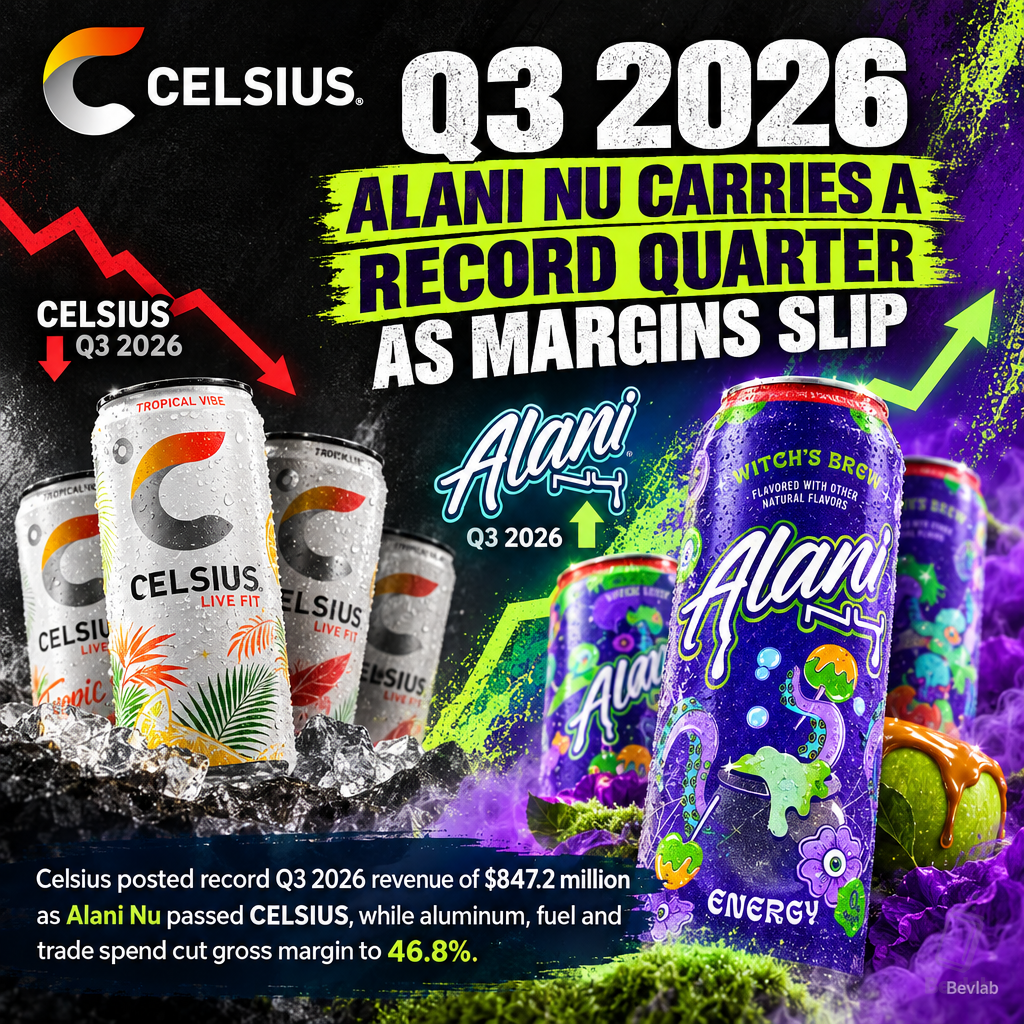
Celsius Holdings booked a record $847.2 million in revenue for the third quarter of 2026, up 16.8% from $725.1 million a year earlier. That total covers a portfolio pulling in different directions. Alani Nu carried the quarter, CELSIUS shrank again, Rockstar Energy is still looking for its floor, and aluminum and diesel took a bigger cut of every can sold.
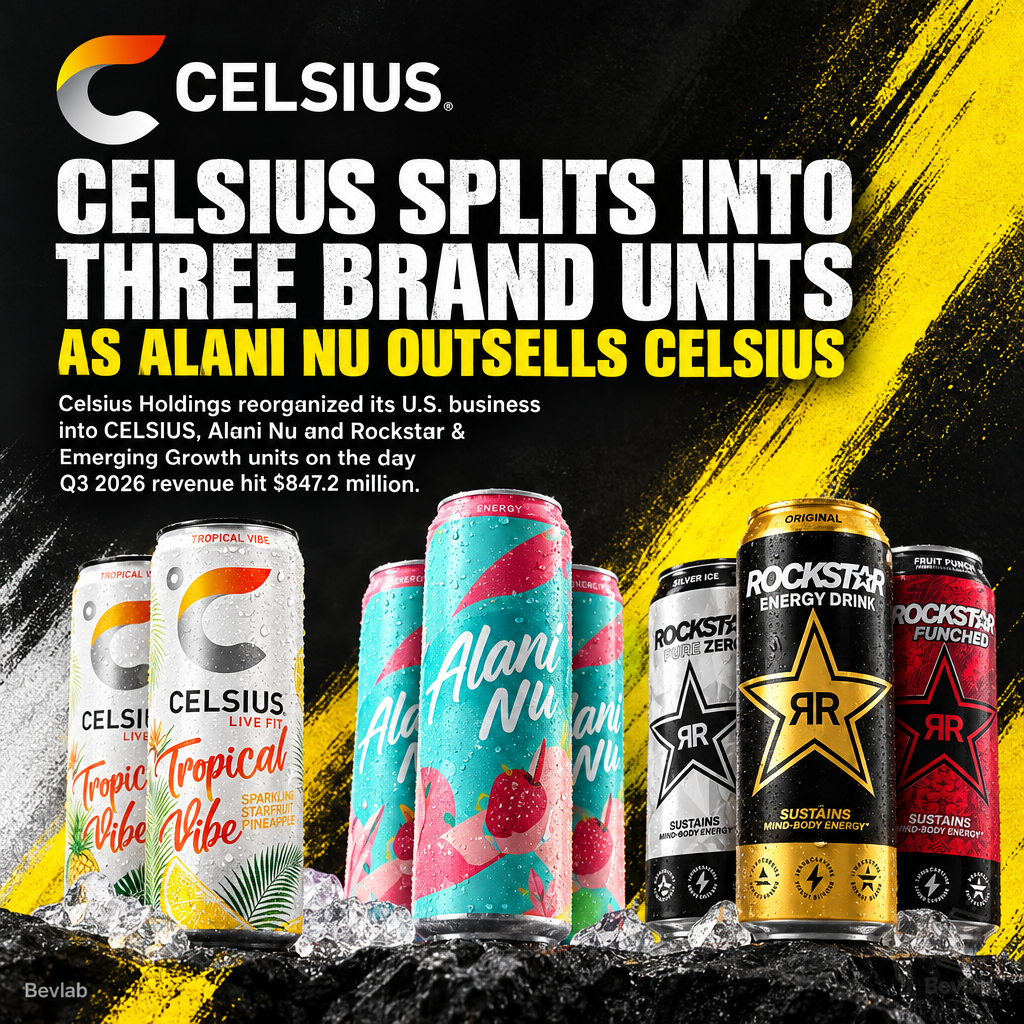
On the same morning, Celsius split its U.S. business into three brand-led units. We covered that move and the new leadership in Celsius Splits Into Three Brand Units as Alani Nu Outsells CELSIUS, so this piece sticks to the numbers, the call, and what turned up in the quarterly filing. For the earlier chapters, see our breakdowns of Q2 2026, Q1 2026 and full-year 2025.
The Quarter in Numbers
- Revenue: $847.2 million, up 17% (nine months: $2,447.8 million, up 36%)
- Gross margin: 46.8%, down 450 basis points from 51.3%
- Net income: $127.0 million, against a $61.0 million loss a year ago
- Diluted EPS: $0.39, against a $0.27 loss per share
- Adjusted diluted EPS: $0.41, against $0.42
- Adjusted EBITDA: $198.6 million (23.4% margin), against $205.6 million (28.4%)
- International revenue: $41.0 million, up 78%
The move from loss to profit comes mostly from an easy comparison. Q3 2025 took a $246.7 million charge for terminating former Alani Nu distributors, and this quarter that line was $3.5 million. Without the one-time items, profit was flat to slightly down. Adjusted EPS slipped a penny and adjusted EBITDA fell 3% on 17% more revenue.
Alani Nu Is Now the Biggest Brand
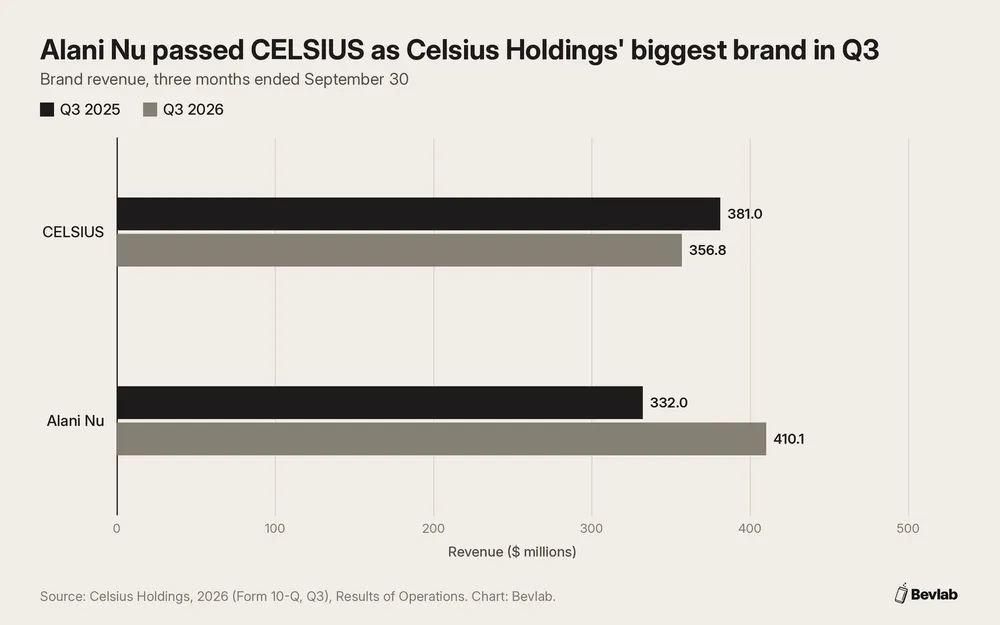
Alani Nu brought in $410.1 million, up 23.5% from $332.0 million, and outsold CELSIUS for the quarter. Retail sales in tracked U.S. channels rose 57.9%, and the brand's dollar share of U.S. RTD energy reached 9.8%. CEO John Fieldly said on the call that the share is up nearly 3 points year over year.
Witch's Brew drove it. Fieldly said the fall limited-time offer brought in more than $130 million in retail sales across traditional retail and club, the largest LTO in the company's history. He said its peak week was the biggest single week any item in the portfolio has ever posted, more than double the next best. Counted as its own brand, it would have been the fifth-largest energy drink in tracked channels that week.
The more important number came without the LTO. Fieldly said core Alani Nu sales in tracked channels grew about 50% excluding Witch's Brew, and the company is moving its best-selling SKUs into the permanent lineup.
So why did 58% scan growth turn into 23.5% reported growth? Celsius's revenue bridge blames a higher share of volume moving through PepsiCo's direct-store-delivery (DSD) system, which carries heavier trade spend and billbacks. It also cites roughly $9 million of amortization tied to the PepsiCo "captaincy" deal and dropped non-RTD products. By the company's math, U.S. RTD energy revenue for the brand grew 29%. CFO Jarrod Langhans said the gap, after removing non-RTD sales and the amortization, has held around 24% to 25% for two quarters. He expects the cleanest comparison in the second quarter of 2027.
CELSIUS Keeps Sliding
The flagship brand posted $356.8 million, down 6.3% from $381.0 million. Tracked retail sales fell 7.0%, and dollar share was 9.1%. That share is going somewhere: to Alani Nu inside Celsius's own house, and outside it to GHOST, which crossed $1 billion in retail sales in the same quarter as Keurig Dr Pepper's energy share topped 10%. Celsius blamed SKU cuts, inventory rebalancing at its largest distributor, and weak club sales, partly offset by lower promotional spend as a share of revenue. Its revenue walk shows U.S. orders running about 6 percentage points behind scan growth, mostly because of inventory rebalancing in the PepsiCo DSD network. International sales and on-the-go powders grew, but scan data doesn't track either one.
Fieldly didn't sugarcoat it: "Brand CELSIUS is not yet where we want it to be." He said the brand has been doing $50 million to $55 million a week in scanner sales. Last year it dipped to about $49 million for a couple of weeks late in the year, so if it holds near $50 million, some weeks around year-end could come in flat or slightly up.
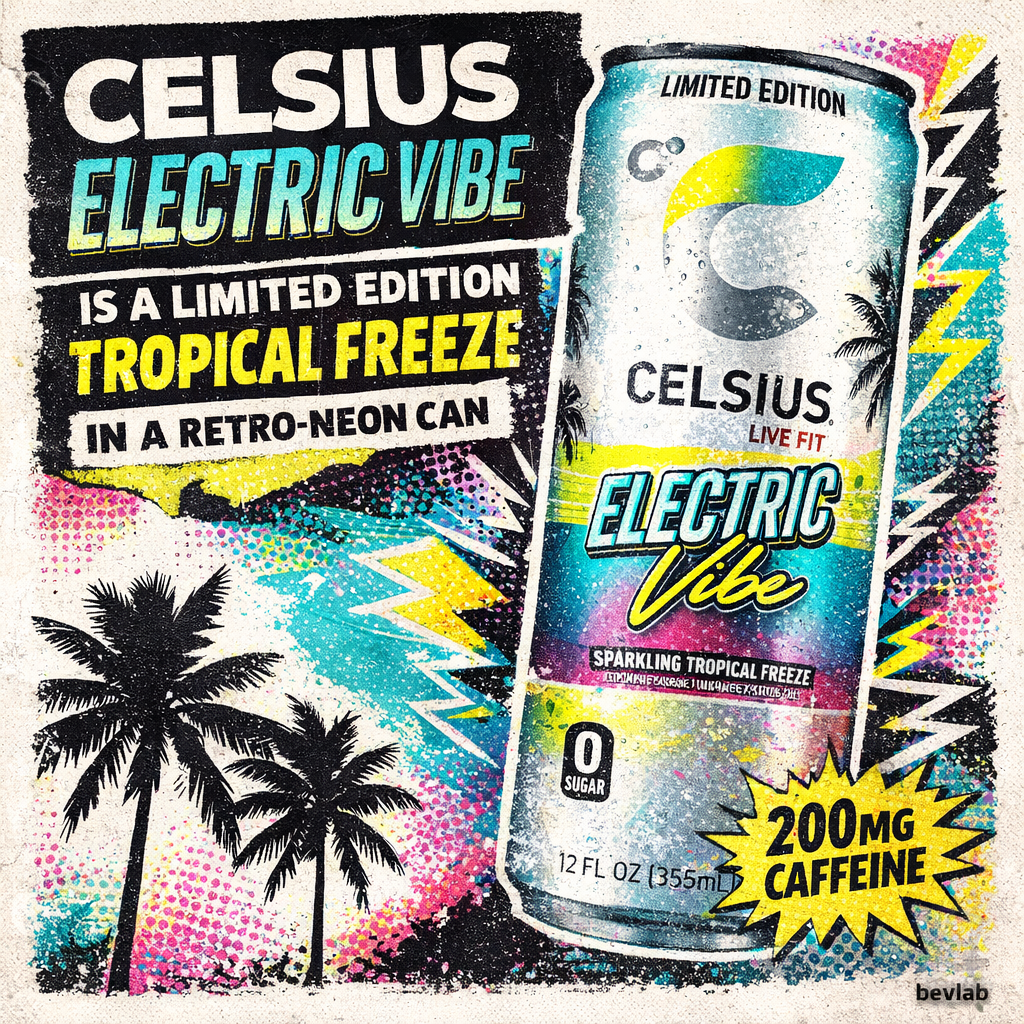
Innovation is the fix, and Celsius held it back in 2026 while it absorbed Alani Nu and Rockstar. Two more CELSIUS SKUs land around Thanksgiving. The 2027 plan includes a Cranberry Apple flavor, more multipacks, a push into 8-ounce packs, and the Energy+ Hydration line. Fieldly said "the portfolio growth is not 100% reliant on Energy Plus success." On the marketing side, CELSIUS signed a multiyear partnership with ESPN College GameDay.
Rockstar: Smaller, Steadier
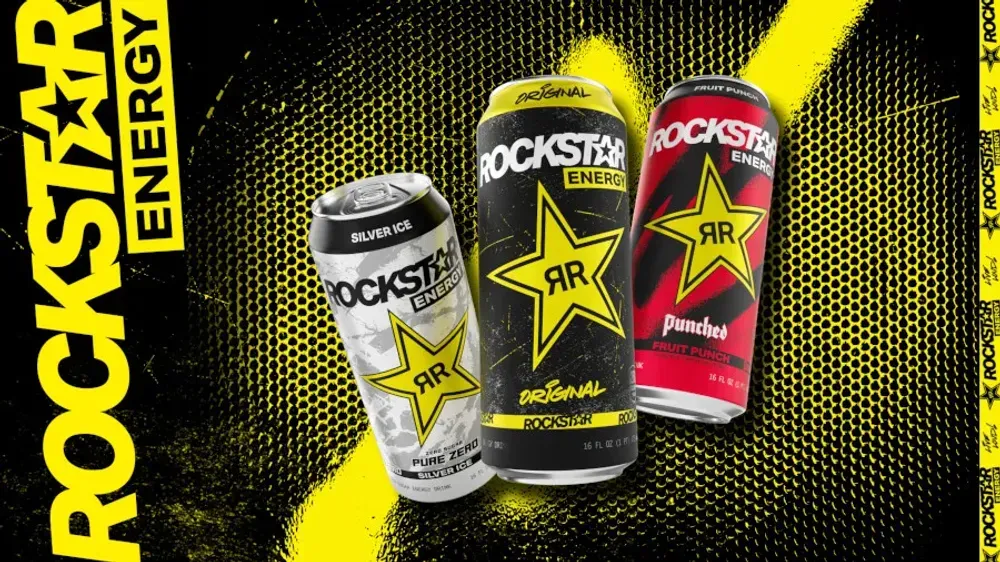
Rockstar added $80.3 million, up from about $67 million in Q2, according to Langhans. Part of that came from Canadian orders that shifted between the second and third quarters. The year-ago figure of $12.2 million only covers August 28 through September 30, 2025, after the acquisition closed.
Scan sales fell 13.2% because of planned SKU cuts (the louder new cans shown at NACS haven't changed the lineup yet), and dollar share was 1.8%. Langhans said dollars per point of distribution rose about 14% from Q2, and Fieldly said the SKUs Celsius kept are running within about 1% of last year. "We are not calling a return to growth today, but the building blocks are coming into place," Langhans said.
Where the Margin Went
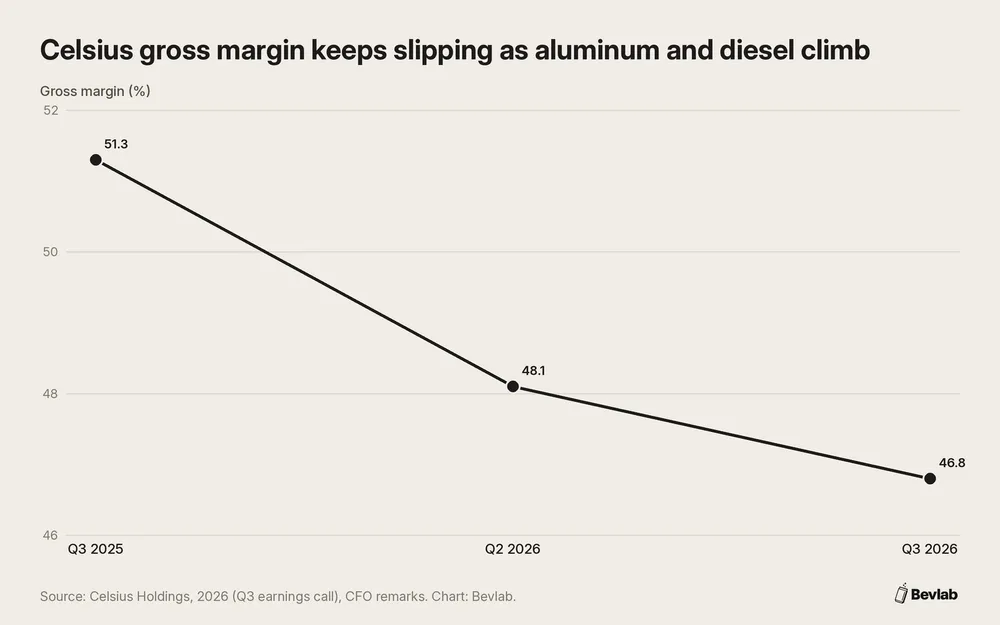
Gross margin was 46.8%, down from 48.1% in Q2 and 51.3% a year ago. Celsius pointed to a higher DSD mix and commodity costs, mainly aluminum and fuel. Outbound freight was $50.4 million, up from $38.5 million. Promotional allowances taken out of revenue rose to $326.8 million from $246.0 million.
In August, Langhans had guided Q3 into the high 40s. He said diesel and aluminum have both climbed since then, with aluminum high on both the LME and the Midwest premium and diesel at its highest level in several years. Raw material costs other than aluminum and fuel improved. The quarterly filing adds that Celsius doesn't hedge commodities, and it lists aluminum cans and sucralose among its input-cost exposures.
The low-50s gross margin target is still the goal, but Langhans said "it's going to take a little longer than we had anticipated a year ago." His main lever is a 2027 revenue growth management program with three parts: a price ladder across CELSIUS, Alani Nu, and Rockstar, consistent pack architecture, and a multiyear pricing and trade roadmap. On list prices, he said, "our posture is to follow the category rather than lead it."
SG&A was $220.7 million, or 26.1% of revenue, down from 28.4% (25.5% on an adjusted basis). That operating leverage pushed adjusted EBITDA margin up from 22.5% in Q2 to 23.4%.
PepsiCo Runs the Route Now
Pepsi accounted for 64.6% of Q3 revenue, up from 35.4% a year earlier. Costco was 10.2%. Pepsi also made up 58.5% of receivables at quarter-end.
The Alani Nu handoff is close to finished. Under an amendment signed May 21, 2026, more former Alani Nu territories moved to Pepsi, and Pepsi reimbursed $81.1 million in related termination fees. Celsius has fully used both reimbursement pools, that one and the original $275.0 million. Distributor termination charges totaled $88.8 million over nine months, and the remaining accrual fell to $2.1 million from $264.1 million at year-end. Accrued promotional allowances rose $171.2 million, partly from the higher DSD mix.
Langhans's Q4 Warning
Langhans listed three items that will drag on Q4 reported revenue:
- Last year's Q4 got a net benefit of about $25 million from the inventory build when Alani Nu moved into DSD, partly offset by CELSIUS inventory cuts. That won't repeat.
- Shipments planned for Q4, which he sized at $20 million to $25 million, landed in Q3 instead.
- Trade spend as a share of gross sales will run higher than a year ago, because Pepsi only started delivering Alani Nu in the first week of December 2025.
The first wave of 2027 innovation loads in during November and December, which partly offsets those. Rockstar's reported growth will look inflated because some of its Q4 2025 sales were booked in other income during the integration. Langhans said underlying Rockstar sales should look more like Q1 and Q2.
He summed it up: "the fourth quarter is the most difficult comparison of the year on a reported basis." He expects reported growth to come in below the first three quarters and blamed timing, "not underlying demand, which you can see in the scanner data."
Outlook and International
Celsius gave no formal revenue or earnings guidance. Management expects full-year gross margin in the high 40s. For 2027, it expects CELSIUS to return to growth, Rockstar to move toward stability and then growth, and Alani Nu to keep benefiting from PepsiCo's DSD system.
International is the steadiest growth line. Europe grew to $32.0 million from $17.7 million, and Asia-Pacific grew to $7.3 million from $3.5 million. Fieldly said aided awareness has roughly doubled in the U.K. and France, Orange is now the top CELSIUS flavor in every Australian account, and Alani Nu should launch in select international markets in 2027. He repeated the target for markets outside the U.S. to reach more than 15% of total revenue within five years.
What the 10-Q Adds
- Still one segment. Celsius now runs three brand units, but as of September 30 the 10-Q still reports a single operating segment, with the CEO reviewing results on a consolidated basis.
- Inventory is up. Net inventory reached $371.8 million, up from $337.7 million at year-end, and the inventory reserve rose to $13.5 million from $9.7 million. Celsius said it built inventory for expected demand, including limited-time offers.
- Supply commitments. Purchase obligations total about $1,003.5 million over five years, mostly cans and other packaging.
- The Flo Rida case is settled. The Strong Arm Productions dispute settled for $85.0 million. Celsius paid $60.0 million on September 15, and $25.0 million is due January 5, 2027.
- More legal and regulatory exposure. In June 2026, the Texas Attorney General issued a civil investigative demand under the state's consumer protection law, and Celsius says it's cooperating. A wrongful-death suit filed in April 2026 against a former Alani Nu distributor alleges caffeine-related harm. Celsius isn't a named defendant but has an obligation to indemnify the distributor. A new securities class action filed September 4, 2026 targets Alani Nu marketing and risk disclosures. In late October, two consumer suits in Washington and Illinois alleged that some CELSIUS label statements are misleading. Celsius says it believes the claims in these matters are without merit.
- Balance sheet. Cash was $700.6 million against $693.0 million of term-loan principal, with a 6.33% effective rate after the July refinancing. Buybacks totaled about $44.5 million in Q3 and $168.8 million year to date, with $91.4 million left under the authorization.
Celsius is now an Alani Nu growth story with a CELSIUS turnaround attached, and Q4 will look weak on paper for reasons management has already laid out. The real test is in 2027: CELSIUS innovation has to show up in scan data, and the pricing program has to win back the margin that aluminum keeps taking.
Tagged