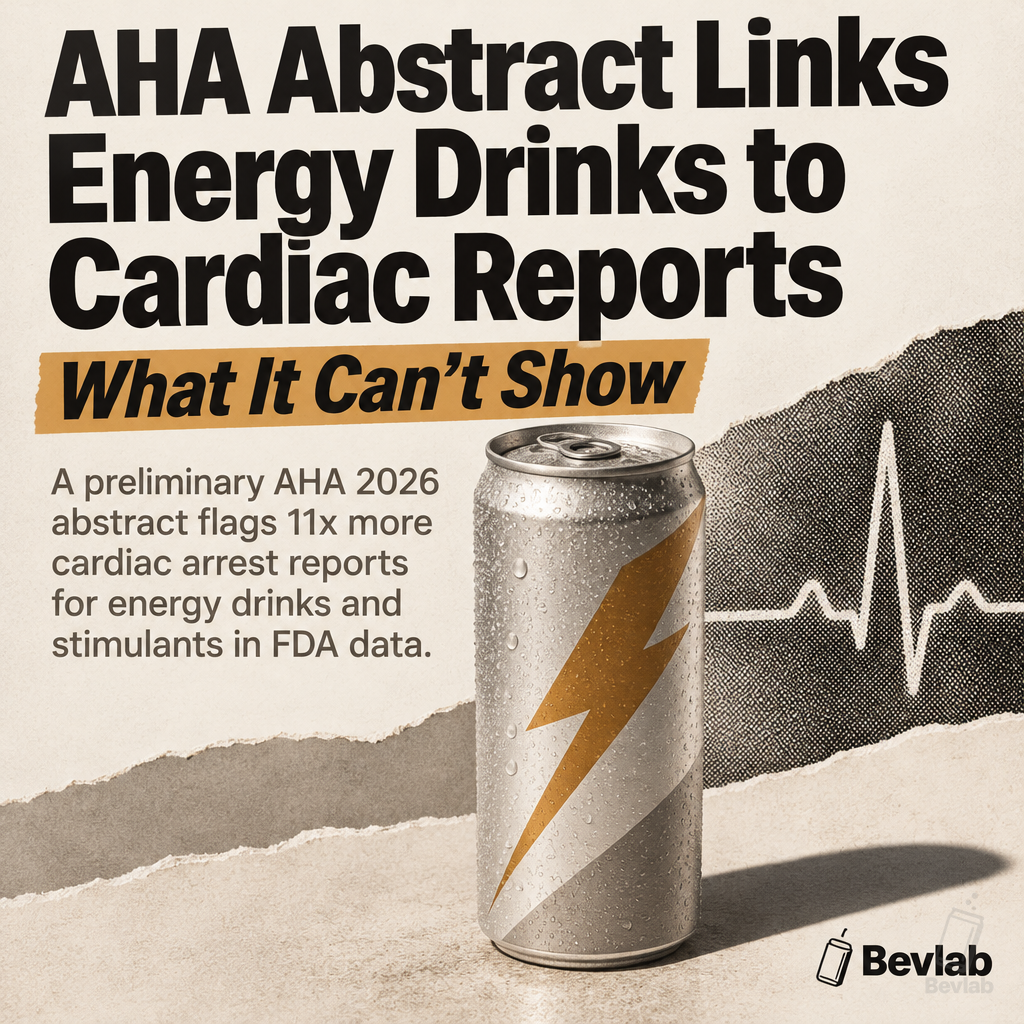
AHA Abstract Links Energy Drinks to Cardiac Reports: What It Can't Show
A preliminary AHA 2026 abstract flags 11x more cardiac arrest reports for energy drinks and stimulants in FDA data. Here's what it can't prove.
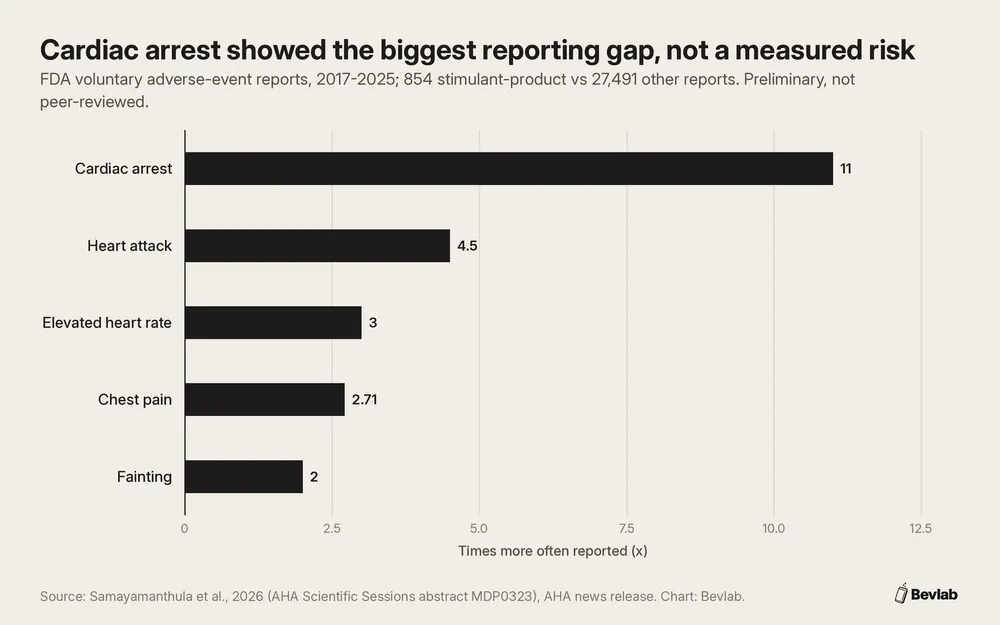
A new abstract presented at the American Heart Association's Scientific Sessions 2026 in Chicago found that cardiac arrest showed up about 11 times more often in FDA adverse-event reports involving caffeine- and stimulant-containing energy drinks and supplements than in reports about other foods and supplements.[1] That number is already spreading on social media, where one November 8 post on X drew tens of thousands of views,[3] and it's easy to misread it as "energy drinks make cardiac arrest 11 times more likely."
The study doesn't show that. It's a preliminary abstract that hasn't been peer-reviewed. It measures how often certain problems appear in voluntary reports, not how often they happen to people who drink these products.
What the Abstract Found
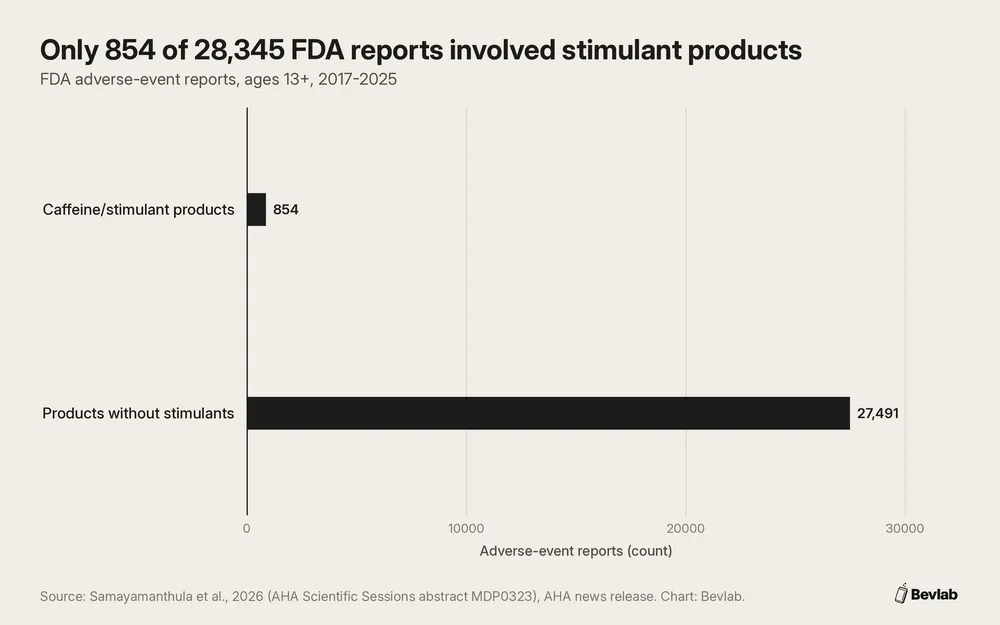
The abstract is MDP0323, from Sai Samayamanthula and colleagues at the University of Virginia School of Medicine. The team looked at 28,345 reports filed with an FDA safety database from 2017 to 2025, covering people ages 13 and up. Of those, 854 mentioned energy drinks or dietary supplements containing caffeine or other stimulants. The other 27,491 involved products such as soft drinks, meal replacement shakes, protein bars, smoothies, and vitamins.[1]
Compared with that group, the stimulant reports were:
- About 11 times more likely to mention cardiac arrest
- About 4.5 times more likely to mention a heart attack
- About four times more likely to mention ventricular arrhythmias or palpitations
- Nearly three times more likely to mention elevated heart rate, 2.71 times for chest pain, and about twice as likely for fainting
About 45% of the stimulant-linked heart reports involved adults ages 18 to 34. Men and women showed similar patterns.[1]
What Voluntary Reports Can't Show
Read every multiplier above as a reporting ratio. It compares how often a heart event appears among reports about one group of products with how often it appears among reports about another. It doesn't measure anyone's risk.
The data has three built-in blind spots:
- No denominator. Consumers, doctors, and manufacturers submit these reports voluntarily, so nobody knows how many people used the products without problems or how many had a heart event and never reported it.[1]
- No cause. The authors said the design can only find associations and can't prove the products caused any heart event.[1]
- Broad grouping. Products were sorted by ingredient rather than brand. The stimulant group pooled caffeine, methylxanthines (theobromine, guarana, yerba mate, and green tea or coffee extracts), and sympathomimetics such as synephrine, yohimbine, ephedra, DMAA, and higenamine.[1] Ephedra, DMAA, and higenamine can't legally be sold in food or dietary supplements. The analysis also didn't separate canned energy drinks from energy shots, pills, or powders such as pre-workouts.[2]
Dr. Gregory Marcus, who chaired the AHA's 2026 scientific statement on caffeine and wasn't involved in the study, said the results raise concern about very high-caffeine products. He added that the study "does not prove that caffeine products cause these events, because other factors may have influenced the results found in this analysis."[1]
No Full Text Yet
As of November 10, 2026, there's no public full text, methods detail, confidence intervals, or manuscript. We checked the AHA newsroom, the Scientific Sessions abstract planner, AHA journals, and PubMed. Until one of those turns up, Bevlab isn't drawing conclusions from this abstract. We'll update this article when the abstract appears in the Circulation supplement or a full paper is published.
CRN Pushes Back
The Council for Responsible Nutrition (CRN), the supplement industry's trade group, says the study lumps together very different products and ingredients without checking what people actually took or how much.[2]
"Importantly, the reported 11-fold difference in cardiac arrest reporting does not mean consumers are 11 times more likely to experience cardiac arrest," said Andrea Wong, Ph.D., CRN's chief science officer.[2]
CRN also pointed to factors the analysis doesn't appear to account for: alcohol, medications, total caffeine from other sources, physical activity, and underlying health conditions. It added that the findings don't show young adults face more cardiovascular risk than other age groups.[2] The researchers have offered a similar list of possibilities for the young-adult pattern. It could reflect how often young adults use these products, using them before intense exercise or with alcohol or drugs, or undiagnosed heart conditions.[1]
The AHA's Caffeine Guidance
The AHA's 2026 scientific statement says up to 400mg of caffeine a day is generally safe for most adults. That's about five 8oz cups of regular black coffee.[1] The AHA also notes that high caffeine doses have been associated with cardiovascular harm, and that clinicians have described irregular heart rhythms in people who had consumed these products.[1]
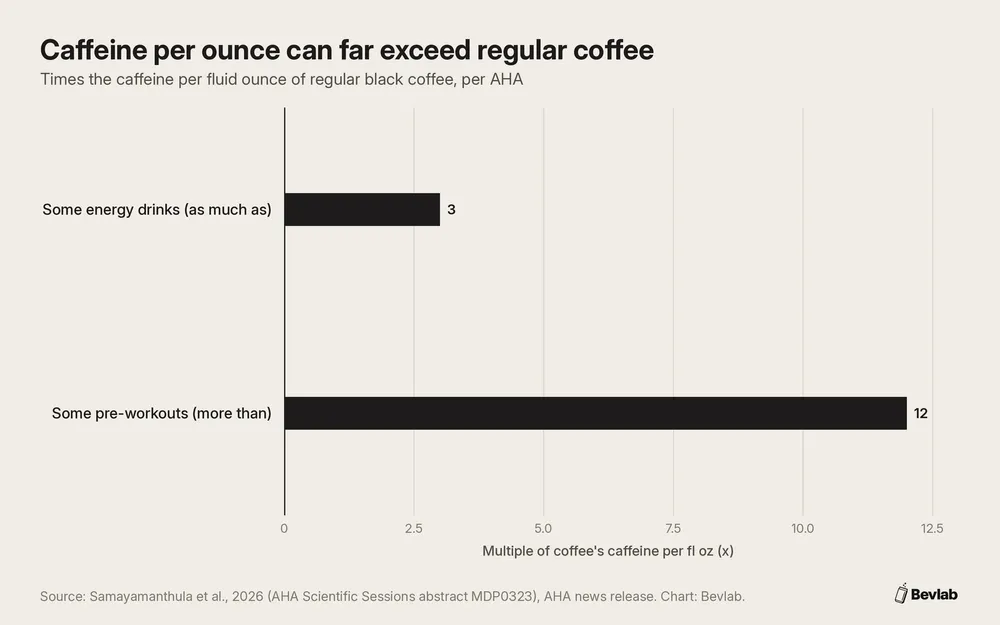
The AHA says some energy drinks carry up to three times as much caffeine per fluid ounce as brewed coffee, and some pre-workouts more than 12 times as much.[1] CRN counters that serving sizes vary widely, so per-ounce numbers alone don't tell you how much caffeine you're getting.[2]
What to Do Right Now
Samayamanthula said that for many healthy people who use these products occasionally, "the risk is probably small," but regular users can quickly go over the daily caffeine limit.[1] In practice:
- Count all your caffeine. Add up your cans, coffee, shots, and pre-workout.
- Don't mix stimulants with alcohol, and don't stack them on top of an all-out training session.
- See a doctor if you get palpitations, chest pain, or fainting, or if you have a heart condition and use stimulant products.
This abstract is a signal for researchers to dig into, not proof that your can is dangerous. Keep your total caffeine in check while the full data stays unpublished.
References
-
American Heart Association. "Energy drinks, stimulant products linked to cardiac arrest, heart attack in young adults." AHA Newsroom, November 2, 2026. https://newsroom.heart.org/news/energy-drinks-stimulant-products-linked-to-cardiac-arrest-heart-attack-in-young-adults
-
Council for Responsible Nutrition. "CRN Responds to Preliminary Study on Caffeinated Products and Cardiovascular Events." 2026. https://crnusa.org/node/7801
-
@GuntherEagleman. Post on X, November 8, 2026. https://x.com/GuntherEagleman/status/2119500490165633329
Tagged