Red Bull's No Longer Enough: No boost For Volleyball Players in New Trial
One 8.4 oz Red Bull (about 80mg caffeine) did nothing for female volleyball players' strength, jumps or sprint power in a new trial.
A new randomized trial revealed that a single 8.4oz can of Red Bull did nothing measurable for a squad of female volleyball players. It didn't help their grip, their jumps, or their 30-second sprint.[1] Before anyone piles on the can, look at the dose. This is about 80mg of caffeine, which is well under the amount performance research usually tests.
Inside the Volleyball Trial
The study comes from researchers at the University of South Bohemia in České Budějovice, Czech Republic, led by Helena Estella Harrisová. It was published in Nutrition and Health in 2026.[1] The authors reported no funding and no conflicts of interest.[1]
They recruited 15 players from the Czech Women's First League, the country's second-highest level. The players averaged 21.3 years old and 70.2kg, and the group included hitters, middle blockers, liberos, and setters. None of them drank energy drinks regularly.[1]
The trial was a crossover design, which means every player was tested once with Red Bull and once with a placebo, one week apart. The paper describes it as double-blind. The placebo was Schweppes Ginger Ale mixed with lemon tea and lemon concentrate to copy Red Bull's taste and look. Both drinks came in opaque bottles with straws.[1]
Before each session, players skipped caffeine for 24 hours and didn't eat for at least an hour. They finished the drink in about 3 minutes, sat for 20 minutes, and then warmed up. Testing started with grip strength at about 33 minutes, then jumps, then a 30-second all-out Wingate cycling sprint at about 37 minutes.[1]
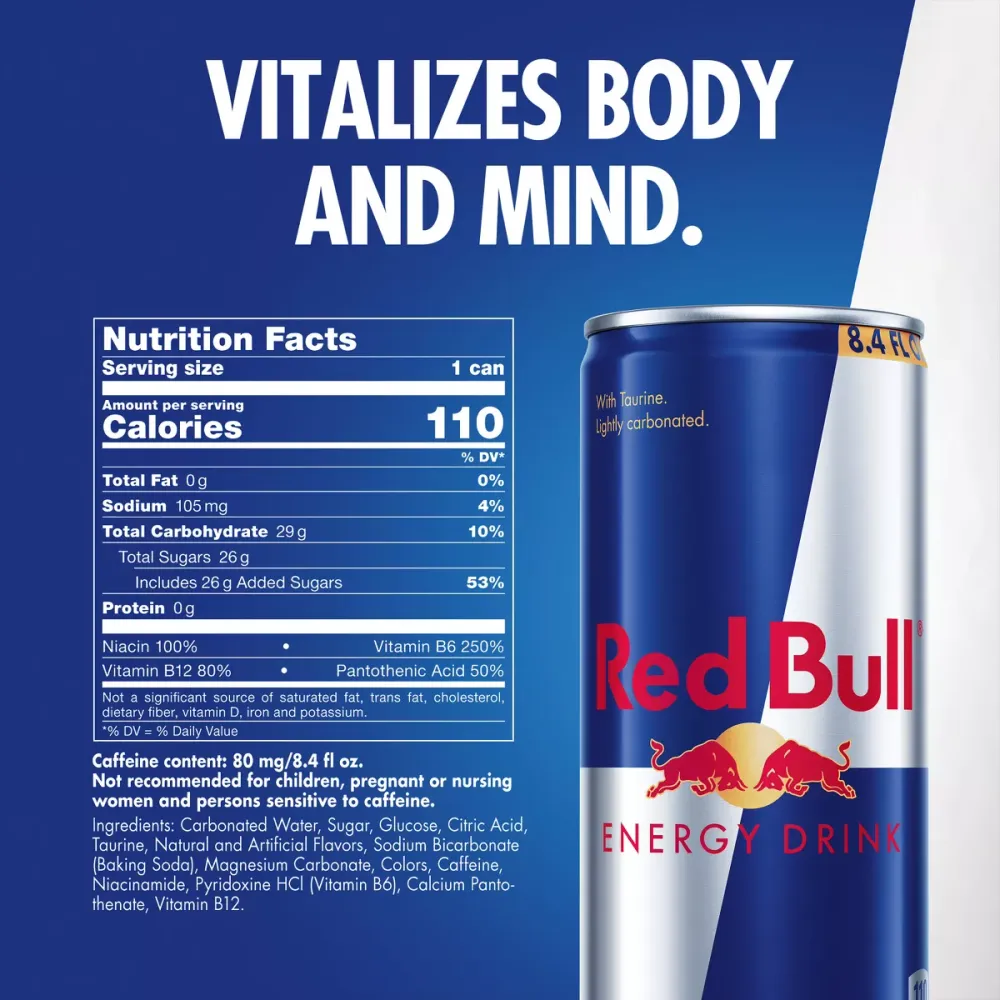
One 8.4 fl oz Can, About 80mg Caffeine
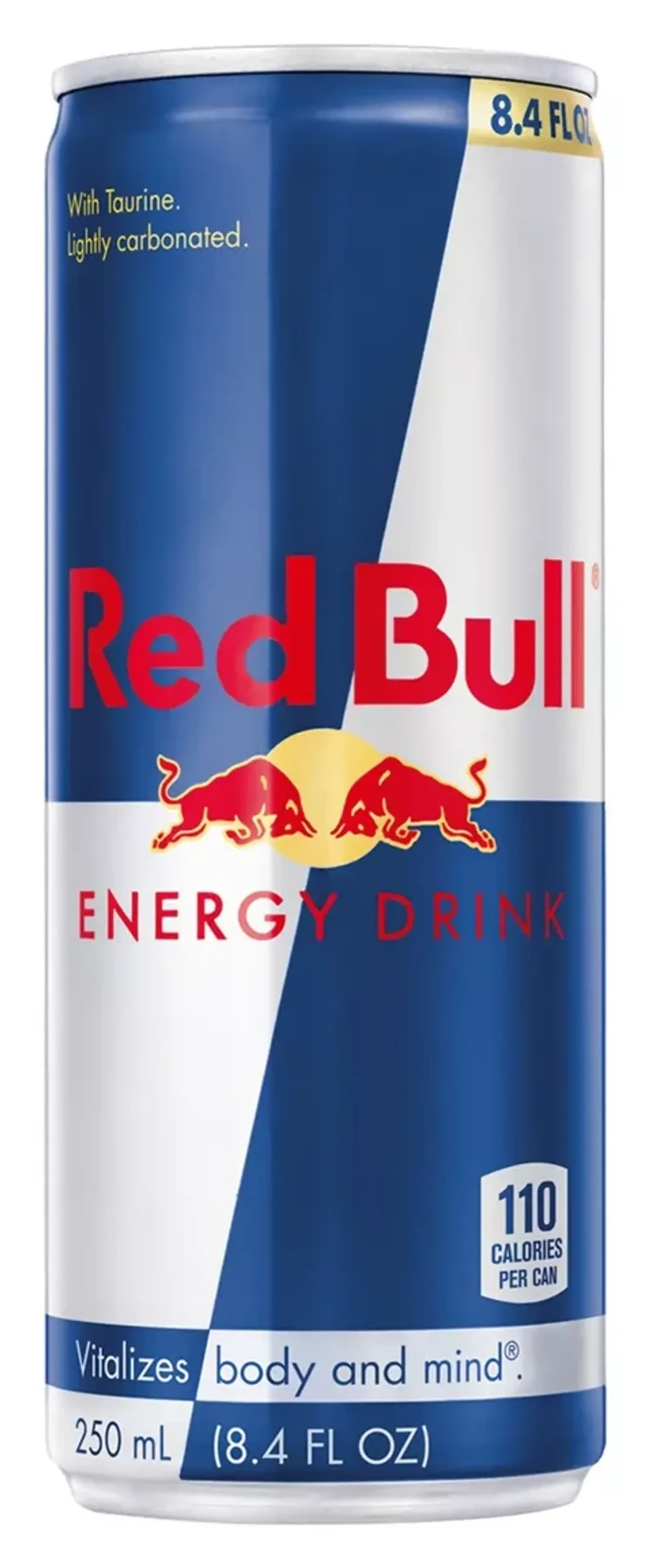
Each player drank 3.57mL of Red Bull per kg of body weight. That averaged 250.7mL (plus or minus 28.2mL), which is about one standard 250mL (8.4 fl oz) can. It delivered an average of 80.3mg of caffeine (plus or minus 9.0mg), or 1.143mg/kg.[1]
The 8.4 fl oz can started the whole energy drink category. Next to today's 200-300mg cans, it now counts as a low-caffeine option. Plenty of people still crack one before a workout, but it isn't dosed like a pre-workout.
Thirteen Measures, No Wins
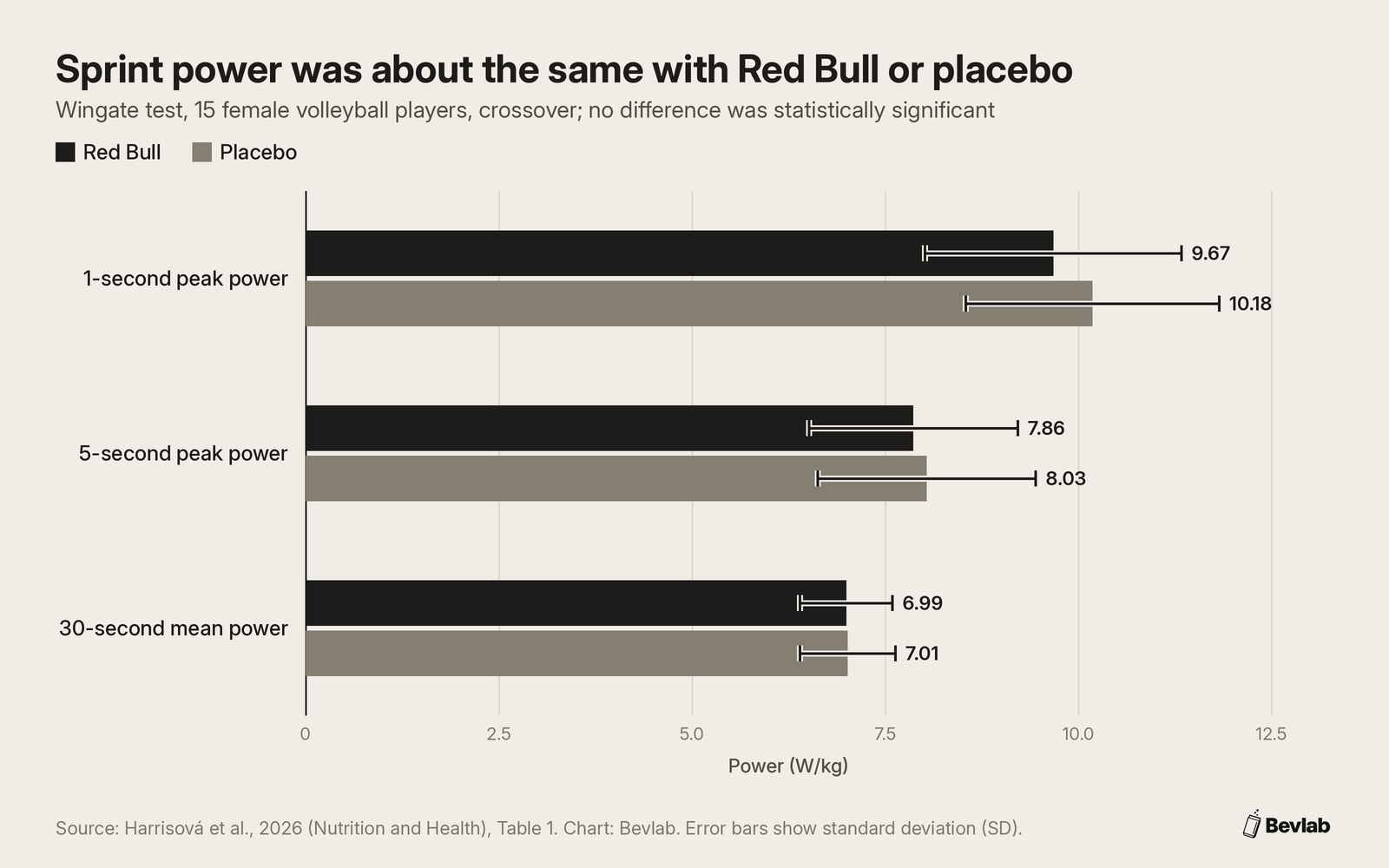
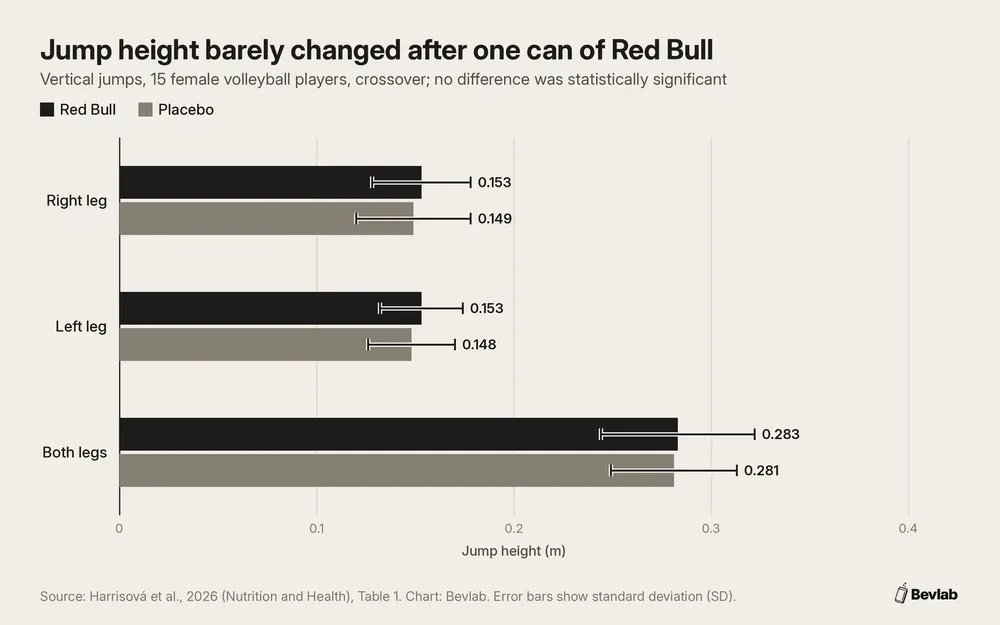
The researchers tracked 13 measures, and none of them differed significantly between Red Bull and placebo.[1] "Statistically significant" means a difference is big and consistent enough that chance alone is an unlikely explanation. None of these differences reached that bar.
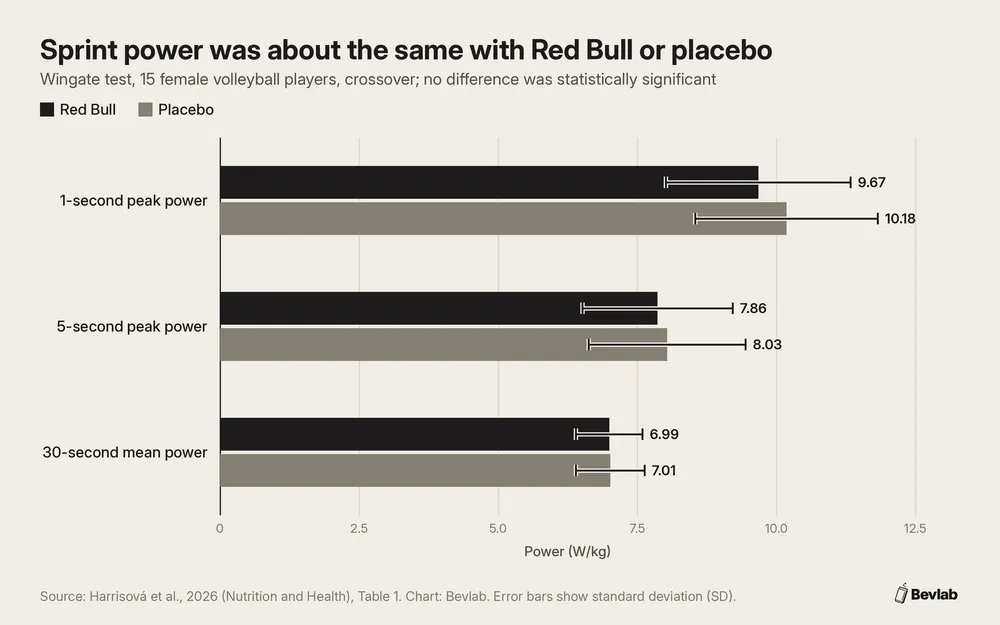
- Peak sprint power was slightly higher on placebo (10.18 vs. 9.67 W/kg).
- Right-hand grip was 29.6kg on Red Bull vs. 28.2kg on placebo.
- Both-legs jump came in at 0.283m vs. 0.281m.
- 30-second mean power was 6.99 vs. 7.01 W/kg.
- Perceived effort was 15.7 vs. 15.9 on the 6-20 Borg scale.
The team also reported Cohen's d, an effect size that measures how big a difference is regardless of how many people were tested. Roughly, 0.2 is small, 0.5 is medium, and 0.8 is large. Every effect here was 0.40 or smaller, and they pointed both ways. Some measures favored Red Bull and others favored placebo.[1]
There was one difference. Eight of the 15 players reported mild nausea after Red Bull, mostly after the sprint, and nobody reported it after placebo.[1] The authors think it probably didn't affect the scores, but the two drinks clearly weren't tolerated equally.
The Caffeine Doses Research Uses
The authors' explanation is simple. About 1.14mg/kg falls below the 3-6mg/kg range most consistently linked to performance benefits.[1,5] They concluded that a single standard serving may not provide enough caffeine to help with short, high-intensity efforts.[1]
For a 70kg (154lb) person, 3-6mg/kg works out to roughly 210-420mg of caffeine. That's about 3 to 5 original Red Bulls, or a single high-stim can.
Other research points the same way. Astorino and colleagues gave women athletes a standard Red Bull serving (about 1.3mg/kg caffeine) and saw no improvement in repeated sprints.[3] At about 3mg/kg, caffeinated energy drinks improved jump height and ball speed in volleyball players, including elite female players.[4] Bevlab's One Caffeine Dose, 3.5 Hours of Repeated-Sprint Benefits covered a study where about 5.5mg/kg (roughly 385mg for a 70kg person) raised repeated-sprint power in 12 young adults.
That doesn't mean you should chase the top of the range. The FDA generally cites 400mg per day as an amount not usually linked to negative effects in healthy adults, and tolerance varies from person to person.[6] The nausea in this trial is another good reason not to chug a can right before going all-out.
Limits of the Study
Fifteen players is a small sample. That gives each test limited statistical power (the ability to detect a real difference), so small effects can't be ruled out. The researchers never checked blinding by asking players which drink they thought they'd had. The placebo also wasn't matched to Red Bull's carbohydrates or calories, menstrual cycle phase wasn't tracked, positions were mixed, and lactate was measured only 30 seconds after the sprint.[1]
The ClinicalTrials.gov registration was submitted in August 2025, after testing ran from November 2024 to mid-2025, and it lists masking for participants only, while the paper describes the trial as double-blind.[2]
None of this shows Red Bull "doesn't work". It shows that one 80mg can, taken about 35 minutes before short, all-out efforts, didn't measurably help these athletes. If you want a performance edge from caffeine, the research is built around doses several times higher. And preferably with something that won't give over half the players nausea.
References
-
Harrisová HE, Bahenský P, Mrkvička T, Krajcigr M, Marko D, Bago G, Čepička L. "The effect of Red Bull energy drink on strength, power, and jump performance in female volleyball players: A randomized cross-over trial." Nutrition and Health, 2026. https://pubmed.ncbi.nlm.nih.gov/42858003/
-
ClinicalTrials.gov. "The Influence of Red Bull Energy Drink on the Speed, Strength and Rebound Performance of Female Volleyball Players at the Performance Level (NCT07133061)." https://clinicaltrials.gov/study/NCT07133061
-
Astorino TA, Matera AJ, Basinger J, et al. "Effects of Red Bull energy drink on repeated sprint performance in women athletes." Amino Acids, 2012. https://doi.org/10.1007/s00726-011-0900-8
-
Pérez-López A, Salinero JJ, Abian-Vicen J, et al. "Caffeinated energy drinks improve volleyball performance in elite female players." Medicine & Science in Sports & Exercise, 2015. https://pubmed.ncbi.nlm.nih.gov/25051390/
-
Guest NS, VanDusseldorp TA, Nelson MT, et al. "International Society of Sports Nutrition position stand: caffeine and exercise performance." Journal of the International Society of Sports Nutrition, 2021. https://doi.org/10.1186/s12970-020-00383-4
-
U.S. Food and Drug Administration. "Spilling the Beans: How Much Caffeine Is Too Much?" https://www.fda.gov/consumers/consumer-updates/spilling-beans-how-much-caffeine-too-much
Tagged