
Soda, Caffeine and Kids' Brains: What the ABCD Study Really Shows
A 9,632-child study tied soda caffeine to small brain differences, but the effects are tiny, the design can't show cause, and experts are skeptical.
Researchers at King's College London have tied kids' caffeine habits to brain differences, and the headlines quickly became "one soda a week shrinks kids' brains." The paper doesn't show that. Once you look at the methods and the numbers, the finding is much smaller and much less certain.
What the Study Found
The study looked at 9,632 kids aged 9 to 11 in the US-based Adolescent Brain Cognitive Development (ABCD) Study. Kids who drank more caffeine had slightly lower total surface area of the cortex, the brain's folded outer layer.[1] Kids who drank more caffeine also slept less. Together, shorter sleep and lower surface area partly explained a link between caffeine and more attention, mood, and behavior problems six months later.[2] By 18 months, only the link through overall surface area remained.[2]
Jiayi Zheng and Divyangana Rakesh published the paper on October 15, 2026, in Biological Psychiatry: Cognitive Neuroscience and Neuroimaging.[3]
How They Measured It
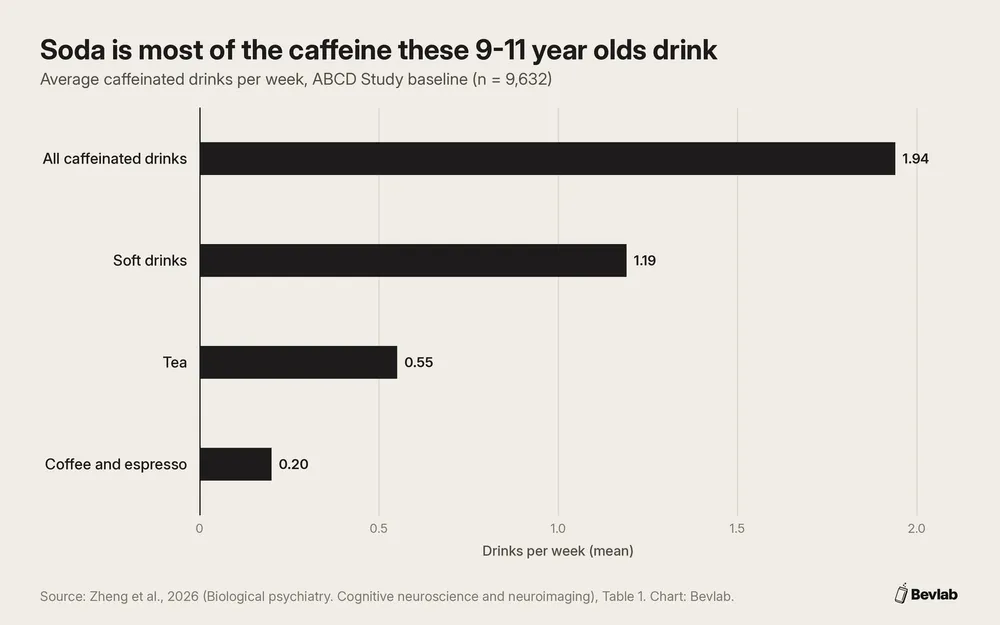
Each child reported how many caffeinated drinks they usually had in a typical week, whether coffee, tea, or soft drinks. Parents reported how long their kids slept. MRI scans measured cortical thickness and surface area at the same visit as the intake report, and the kids self-reported their mental health at the 6-month and 18-month follow-ups. The models adjusted for sex, age, household income, and parental education.[1]
That setup leaves big gaps. The study recorded caffeine intake and brain structure at the same time, so it can't tell you which came first or whether something else drove both. It's observational, so it can't prove that caffeine changed anyone's brain.
The Effects Are Tiny
The main brain result for total caffeine was a standardized effect of -0.03 on total surface area. That's a very small difference, and caffeine showed no link to average cortical thickness.[1] The viral "one cup a week" figure came from exploratory threshold analyses, not the main test.[1]
Here's how the drink types broke down:
- Soft drinks drove most of the surface-area link, starting at one cup per week, with no link to thickness.[1]
- Coffee and espresso showed a small link to thinner cortex but not to surface area.[1]
- Tea showed no link to any brain measure, overall or by region.[1]
The tea result is worth noticing. If caffeine alone were behind the brain differences, you'd expect tea to show something. Zheng says as much: "Soft drinks contain a lot of sugar and often go hand in hand with less healthy lifestyle habits and more risk-taking behaviours, so we can't yet separate the role of caffeine from everything else that comes with them."[2]
Sleep doesn't fully explain the link either. Caffeine was still tied to brain structure after adjusting for sleep, and sleep explained only part of the association.[1] The indirect effects through sleep and surface area were tiny in standardized terms.[1]
What Outside Experts Said
Dr. Charalampos Rallis, a Reader in Genetics at Queen Mary University of London, called it "a large, well-conducted study" that "cannot establish that caffeine causes changes in children's brains." He added: "the observed brain differences are very small. The association with later mental health is negligible."[3]
Prof. Derek Hill of UCL went further, saying "very low confidence must be associated with this finding."[3] He listed four problems:
- The brain scans come from a single timepoint, so there's no measure of how any child's brain changed.
- Sleep came from a parent questionnaire, which is often unreliable.
- The authors didn't link the findings to caffeine dose or timing.
- The kids self-reported their mental health, and no clinician assessed it.
Hill's bottom line: "The conclusions of the paper should be considered speculative."[3]
Where Sleep Fits In
Both outside experts agree on one point. Rallis put it this way: "The most robust conclusion is consistent with existing evidence: caffeine can reduce sleep in children."[3] The authors note that kids often drink soft drinks later in the day, which may hit sleep harder, and they say future studies should record when kids drink caffeine.[1]
Our Take: This Starts at Home
The paper is weak. The trend behind it is not. A generation ago, a middle schooler drinking coffee stood out. Today you'll see 12-year-olds slamming a 200mg energy drink like it's juice, and that's bonkers. Rakesh points out that two-thirds of adolescents have caffeine at least once a week.[2]
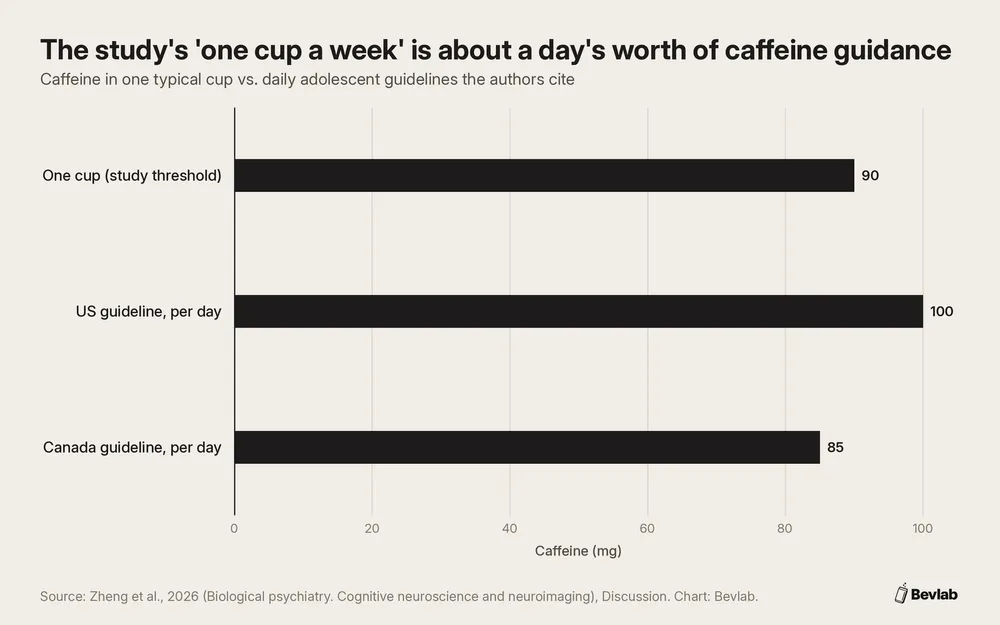
Bevlab covers energy drinks because adults enjoy them. We don't condone kids drinking them, and that goes for caffeinated soda too. The US has no legal caffeine limit for kids. The guideline the study's authors cite is 100mg a day, and they note that few jurisdictions regulate teen caffeine at all.[1] The cans already spell it out, though. Monster has printed "Not recommended for children" on every can since its 2002 launch, and its CEO told the US Senate that many peers followed.[4] Nobody needs a brain scan to act on that.
Parents are the first line of defense, and the first ones accountable. They decide what's in the fridge, what gets bought at the gas station, and whether there's a can on the nightstand at 9pm.
This paper doesn't show that soda shrinks kids' brains. Its one solid finding, that caffeine cuts into kids' sleep, is reason enough for parents to say no.
References
- Zheng, Jiayi et al. "Caffeine Consumption and Adolescent Mental Health: The Role of Sleep and Brain Structure." Biological Psychiatry: Cognitive Neuroscience and Neuroimaging, 2026. https://pubmed.ncbi.nlm.nih.gov/42874917/
- King's College London. "Children's caffeine habits linked to shorter sleep and brain differences." King's College London, 2026. https://www.kcl.ac.uk/news/childrens-caffeine-habits-linked-to-shorter-sleep-and-brain-differences
- Science Media Centre. "Expert reaction to observational study on caffeine consumption in adolescents, sleep and brain structure." Science Media Centre, 2026. https://www.sciencemediacentre.org/expert-reaction-to-observational-study-on-caffeine-consumption-in-adolescents-sleep-and-brain-structure/
- Sacks, Rodney. "Written Testimony of Rodney Sacks, Chairman and Chief Executive Officer, Monster Beverage Corporation." U.S. Senate Committee on Commerce, Science, and Transportation, 2013. https://www.commerce.senate.gov/services/files/3D8EB9DB-8489-49DE-BDAD-293A3A9174F3